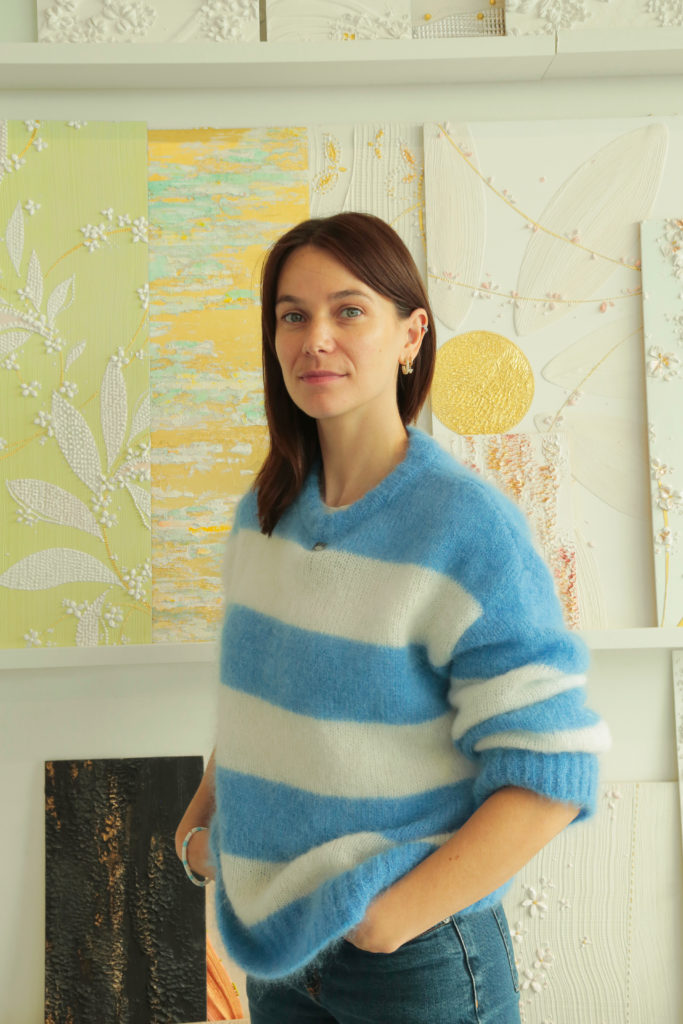
Artist Anne Lopez invites us into her Parisian studio, a place of creation where she transforms matter into poetry and brings to life worlds where lightness and movement meet. She reflects on the path that has shaped her practice, speaks passionately about her work as an artist, and reveals behind-the-scenes insights into her upcoming solo exhibition at Galerie Durst.
EXHIBITION FROM OCTOBER 16 TO NOVEMBER 8, 2025
OPENING RECEPTION ON THURSDAY, OCTOBER 16 FROM 6 PM TO 9:30 PM
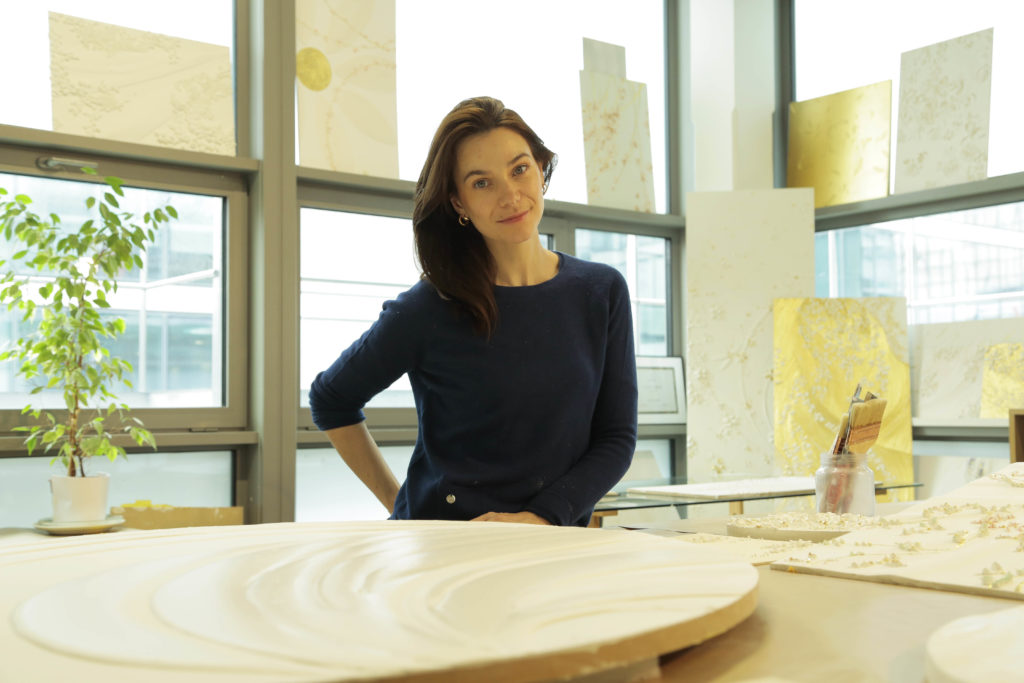
Hello Anne, could you introduce yourself in a few words?
My work consists of bringing to life several unique worlds, each responding to different themes, whether for luxury brands, the interior design sector, or bespoke, one-of-a-kind artworks. I enjoy challenging myself with the demands of new creative realms, which is why I describe myself as a “Creator of Worlds.”
For the past four years, I have been working from my Parisian studio in the 13th arrondissement, where I create wall sculptures and objects, as well as exceptional packaging designs and window display scenographies.
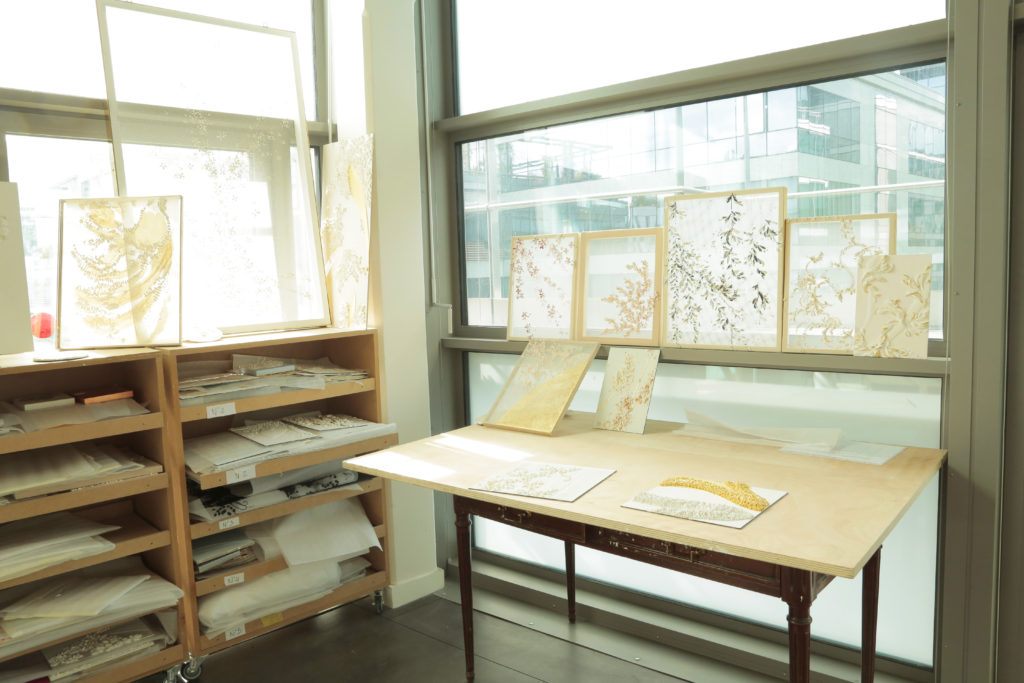
How did art come into your life?
From a very young age, I was introduced to pictorial art by my parents, who often took me to museums. My mother had a particular fondness for the Impressionist period, making the Musée d’Orsay my favorite even today, not only for its paintings but also for its diverse sculptures. Frequent visits to churches sparked my interest in Romanesque, Gothic, and Baroque architecture. My desire to dedicate myself entirely to creation became clear during high school, and I later joined the École Nationale Supérieure des Beaux-Arts in Paris (ENSBA).
What kind of artist are you, and what is your relationship with creativity?
I approach each of my creations with the same passion and intensity. What excites me is infusing my work with a sense of dreaminess, lightness, and grace. My creations are constantly evolving according to my impulses. Each project is an opportunity to experiment with new materials, surfaces, scales, and techniques that fuel my creativity. The desire to constantly reinvent myself has driven me since my years at ENSBA. Above all, I make sure never to be confined to a single style, because “there are no limits in art.”
What are your sources of inspiration?
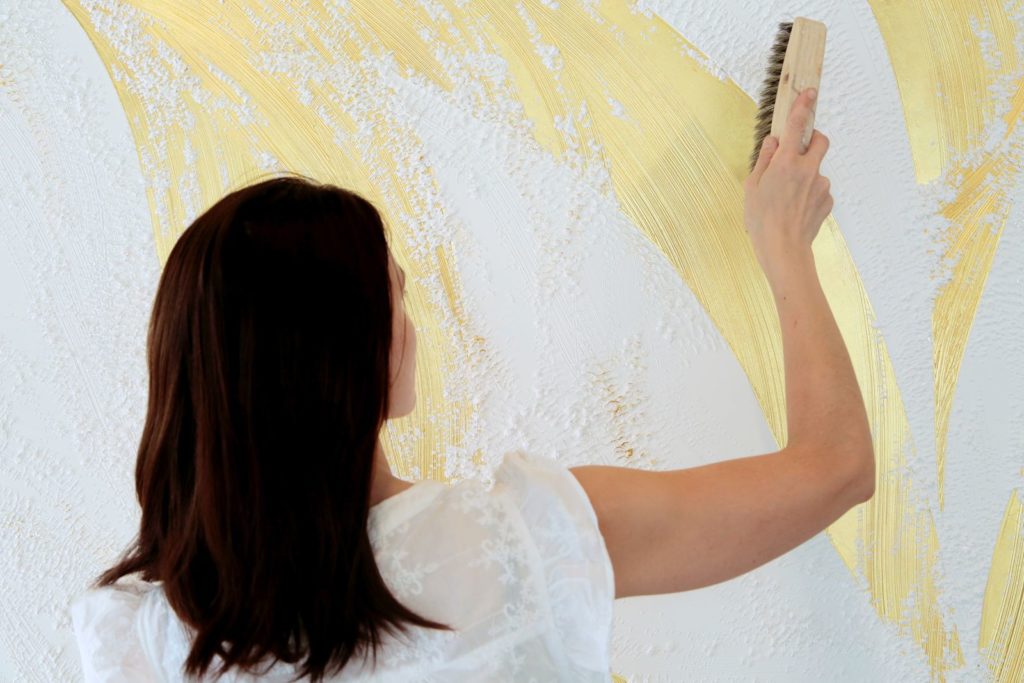
My creativity emerges when I immerse myself in diverse worlds, which I then translate into my favored medium, stucco, according to my imagination. The common thread in my creations is sensuality, the lightness of dance, the beauty of nature, the breath of the wind…
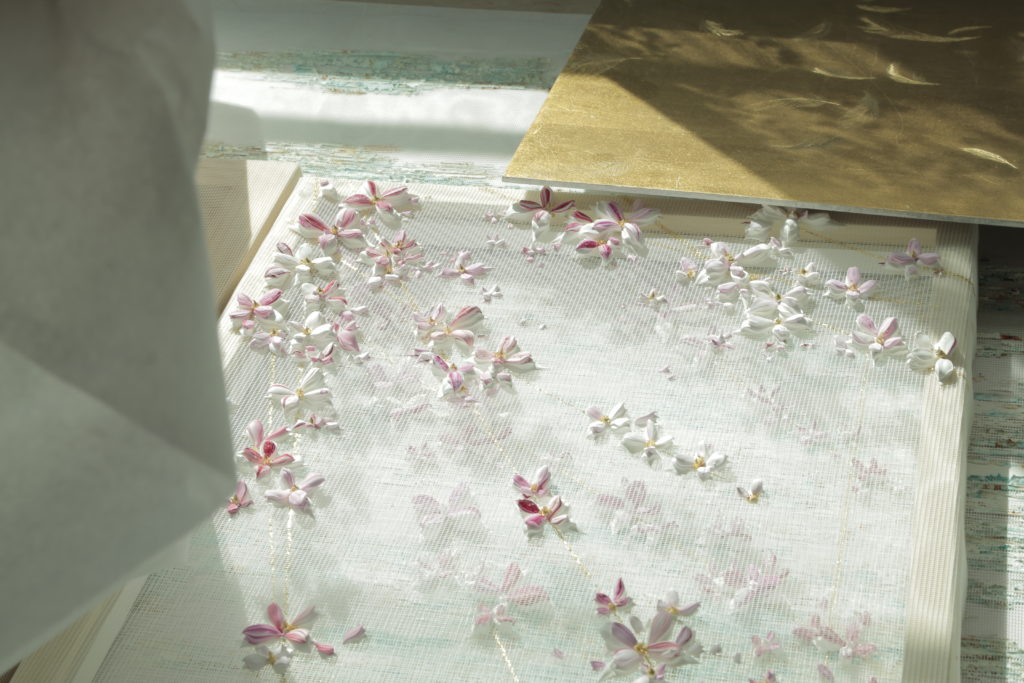
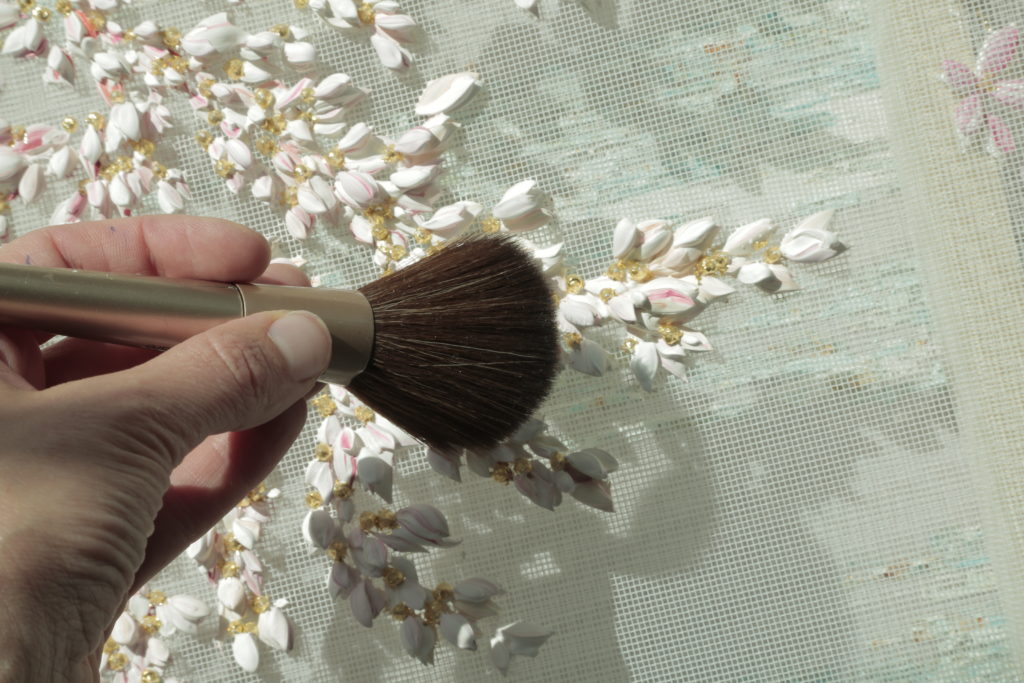
My technique requires full physical engagement. The idea of dance is always present in my work, executed through confident, fluid gestures synchronized with my breathing. Having practiced classical ballet until the age of 20, I developed a way of moving and breathing that has stayed with me ever since.
Are there any artists, movements, or works that have particularly influenced your practice? If so, which ones, and in what way?
The works of the Italian sculptor and painter Bernini (17th century) both fascinate and move me. They have stayed with me throughout my artistic journey. One of his marble sculptures, which I hold particularly dear and discovered at the Galleria Borghese in Rome, is Apollo and Daphne. For me, this work embodies movement and the sense of taking flight.
Graduating from ENSBA in 2017, I furthered my training in 2018 by joining the École d’Art Mural de Versailles to study decorative painting. This allowed me to deepen my appreciation for the Baroque style (mid-16th to mid-18th century), characterized by sinuous lines, scrolls, acanthus leaves, cornucopias, the opulence of details, the exuberance of forms, and the richness of colors, all of which have continually influenced my drawings and compositions. I also have a deep affection for the Impressionist movement (mid-19th century) for its harmonious color palette, with my favorite artist being Berthe Morisot.
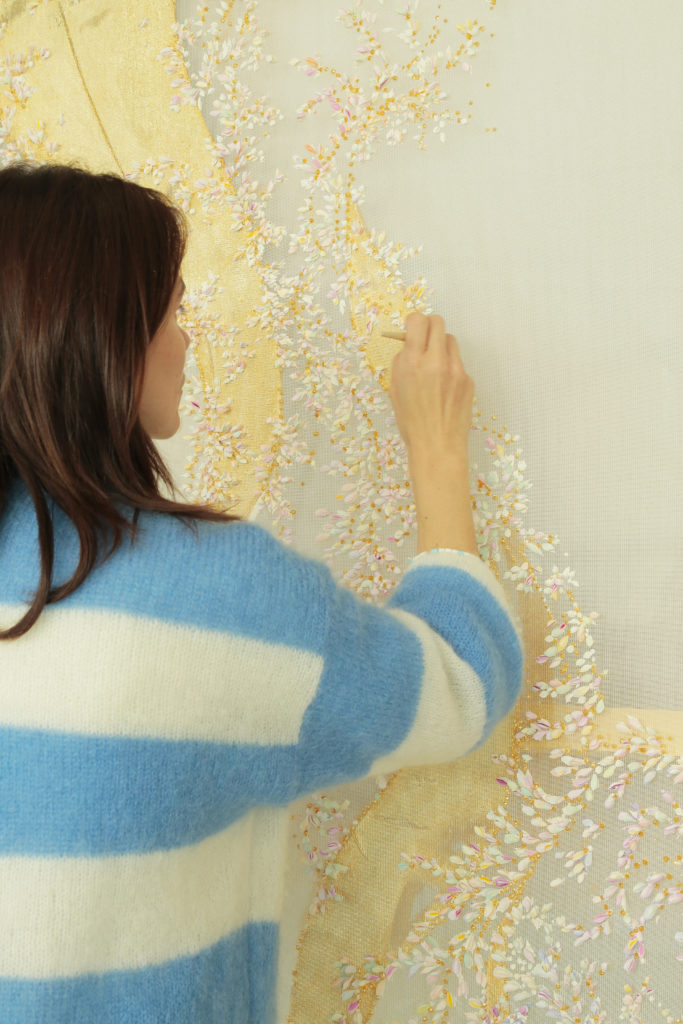
I am constantly in search, particularly in my Matière à Broder collection, for the subtlest, most delicate colors to evoke emotions and feelings. I am also deeply influenced by Art Nouveau (late 19th century) and its elegant, nature-inspired forms, and I have a particular admiration for the jewelry of René Lalique, which continues to shape my work.
How would you define your style and artistic universe?
My style is rather eclectic; I enjoy blending traditional techniques with more inventive and original approaches. I am constantly exploring new realms, diving in with great enthusiasm. I strive to maintain elements of Baroque, sometimes classical, while adding a touch of modernity and freshness inspired by my primary subject of study: nature and plants, which serve as guiding threads for my creativity. My works are always meant to be in motion, never frozen, as if suspended in time. I thrive in a dreamlike, poetic universe that transports me and sparks my imagination.
How did you discover wall sculpture, and what draws you to this medium?
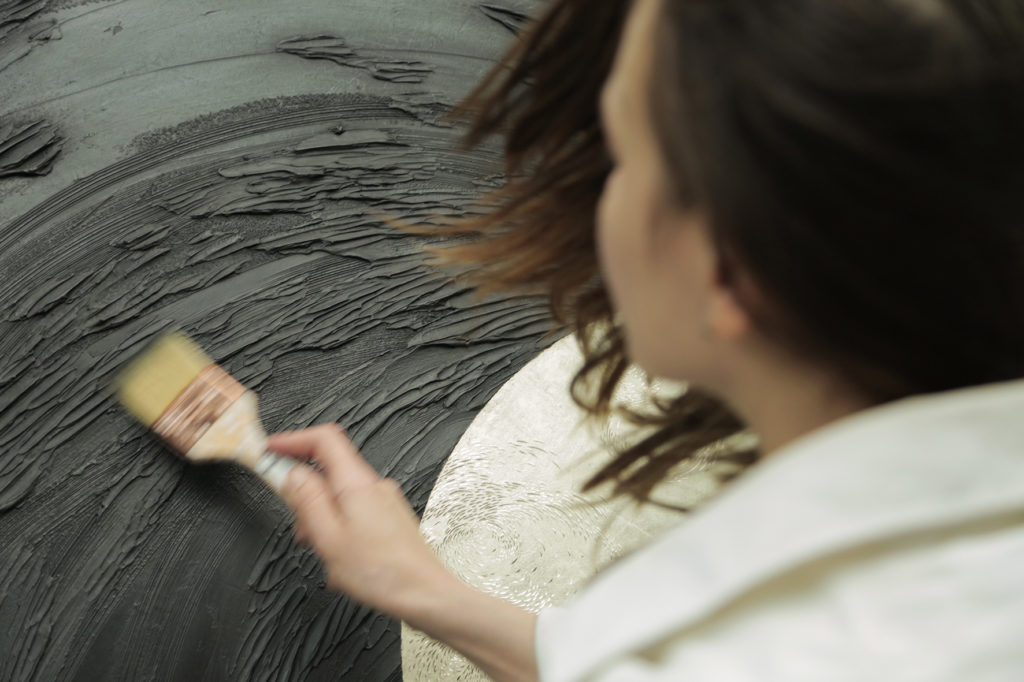
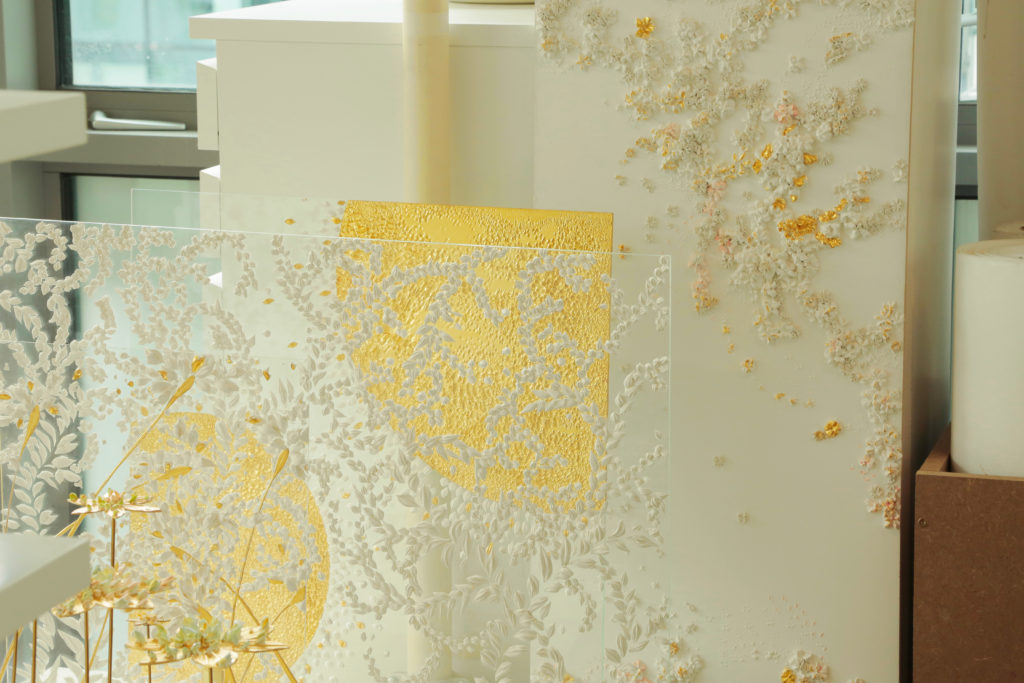
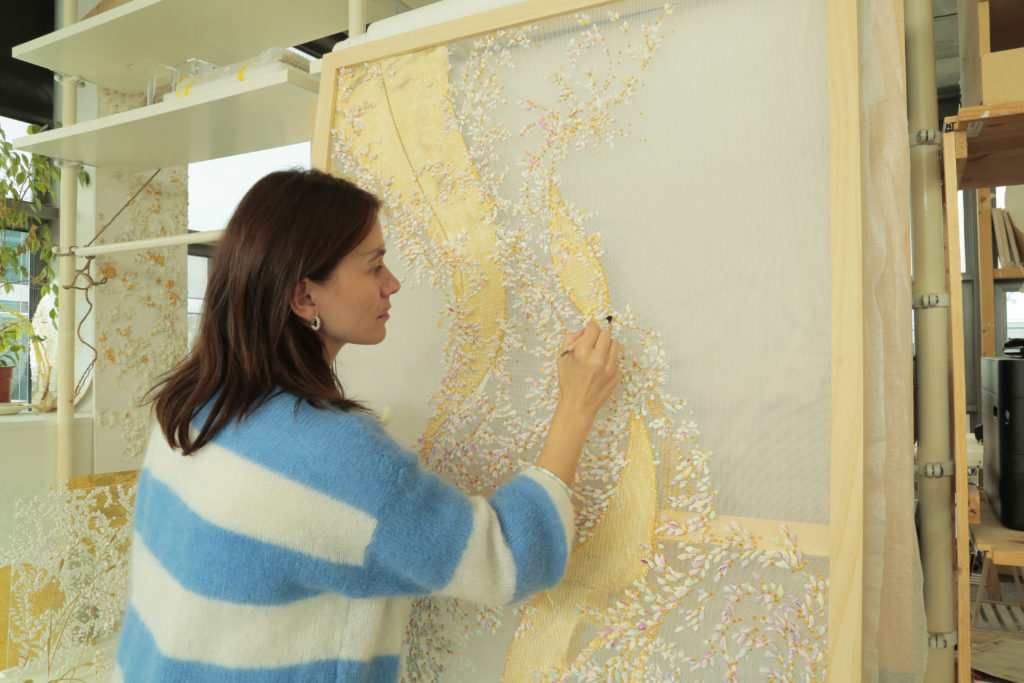
During my studies at ENSBA, I first learned the techniques of drawing and molding. It is through drawing, guided by breathing and dance, that I translate forms into relief and recess. Over time, I developed, through experience, a know-how and method driven by the pursuit of the “perfect gesture” of the wrist and hand, before the material sets. I work with raw mineral plasters, which have a malleable, paste-like texture that hardens upon exposure to air. The sensuality of this luscious, cream-like texture inspires me and allows me to create plants, curves, and organic forms that are always in motion.
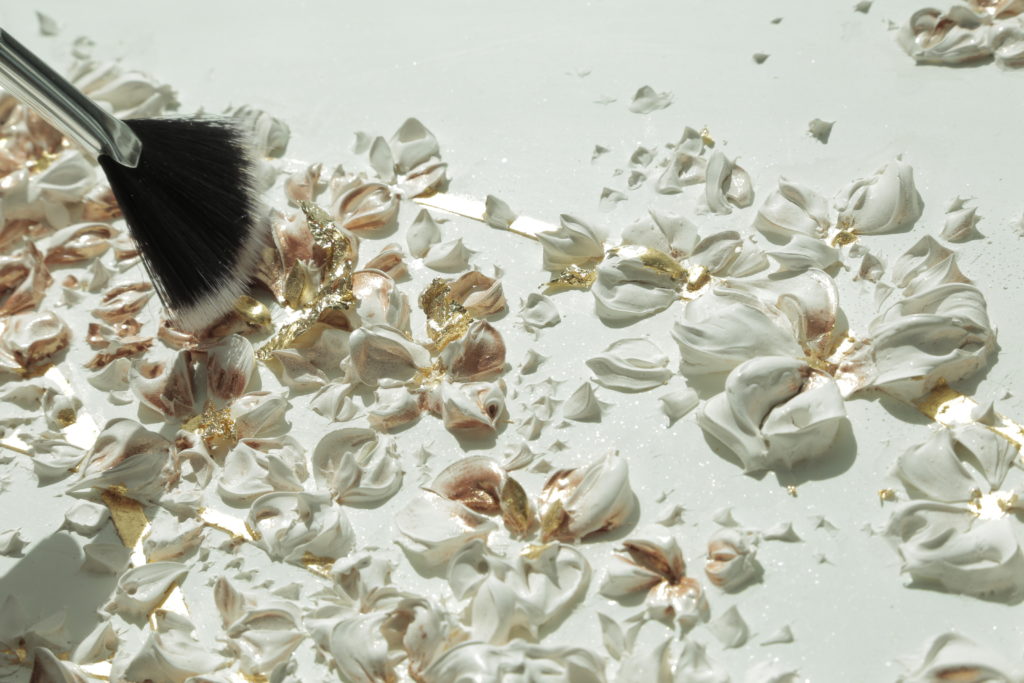
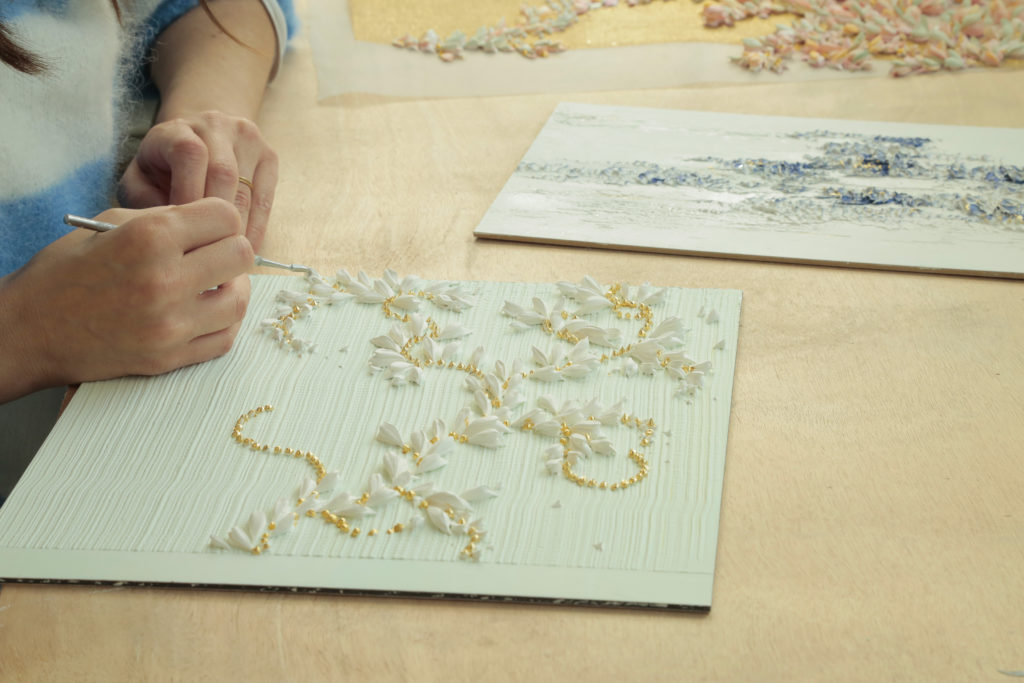
I love the duality between this raw mineral material and its application, its precious appearance when enhanced with gold, and, above all, the surprising forms and functions I choose to give it. What fascinates me is the multitude of shapes my creativity can inspire, whether in the making of a piece of jewelry, decorating a glass bottle, or embellishing a fabric for haute couture. What excites me most is this freedom of expression, where determination and sensuality intertwine.
Could you describe your creative process, from the conception to the realization of a work?
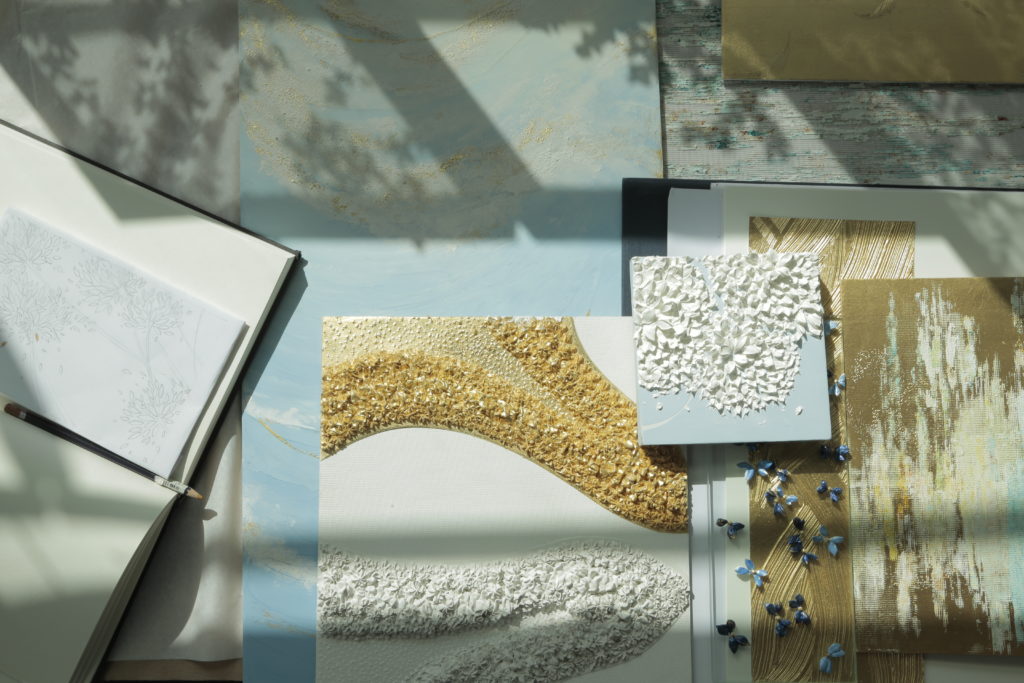
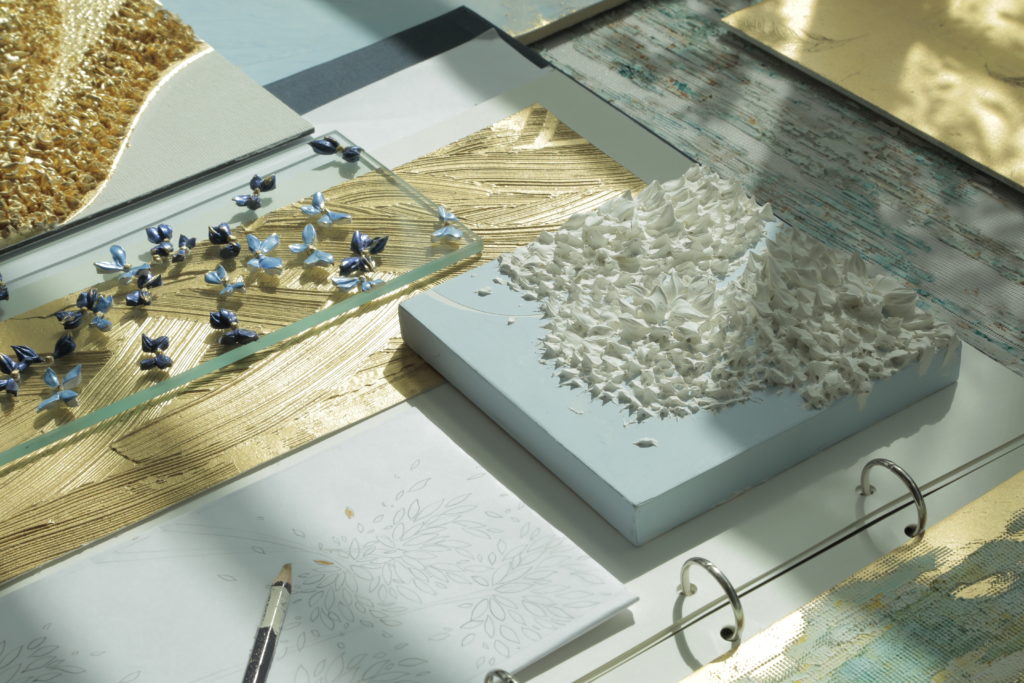
It all begins with a sketch, whether a framed composition or one that escapes the frame, a flourish, a dynamic gesture, an impulse… A simple direction, yet never fixing the final result, because it is the material and its demands that guide my hand. The mineral material is continually explored: pressed, stretched, scratched, applied, sculpted, modeled, adorned with gold or colored glass flakes, touch by touch. I cultivate and make space for the unexpected, even for accidents…
Does your work involve traditional techniques, or do you experiment with more contemporary approaches?
My journey, by its very nature, involves a close relationship between art and craftsmanship. At the École d’Art Mural de Versailles, I learned traditional techniques such as gilding and faux marble, and it is these methods that I reinterpret in my work with a unique sensitivity and artistic universe, developed and refined during my studies at ENSBA. My deep interest in the Decorative Arts drives me to adapt my mineral material for use in techniques I cherish, such as embroidery or jewelry. It is about reinterpreting a method through my own know-how, developed and perfected after years of practice. I am self-taught in the conception of this gesture and this expertise.
Is there a message or emotion you hope to convey through your work?
I like to think that my works evoke a sense of flight, delicacy, letting go, suspended time, and a moment of enchantment.
What is your latest artistic project?
It is a collaboration on an exceptional packaging project with a perfume house, set to launch internationally next October.
Since joining Galerie Durst in 2020, has your style evolved, and if so, in what direction?
When I first joined the gallery, I hadn’t yet had the opportunity to take on as many projects as I do today, projects that encourage me to envision more ambitious works, take greater risks, and push the boundaries of both my creativity and my materials.
How would you briefly describe the spirit of your upcoming solo exhibition at Galerie Durst, Envolée Lyrique?
Multi-material, multi-shaped, blending artisanal techniques across a variety of swirling, dancing supports, all inspired by nature. Each work is an interpretation, an attempt to capture and translate a gesture, a movement.
How did the idea for this exhibition come about, and what does the title mean to you?
This exhibition was born following an invitation from Helena Martin, director of Galerie Durst. We have been collaborating for several years, and since our first meeting, I have developed and created new collections. This exhibition showcases four years of artistic research and creation by presenting key works from these collections.
The title symbolizes the energy and momentum I invest when creating my works, and it is this artistic flight that I aim to convey to viewers. I also love the title for its passionate, sometimes overwhelming character, because one must be fully inspired and driven by passion to create.
Is there a common thread running through this exhibition, or does each work stand alone?
The works are grouped by collection, with each collection having its own theme and distinctive technique, whether inspired by the underwater world, flora, vegetation, or animals. However, although these collections differ in form, they engage in a dialogue with one another. There is no separation between the works; they will be displayed together, side by side, to highlight the hybrid quality present in each piece.
Was there a particular technique or process that you explored while creating this new series?
Yes, for this exhibition, I created my first wall-mounted work from a collection called Champs de Fleurs, which had previously existed only as freestanding sculptures. Approaching the collection from a different perspective allowed me to explore new textures and experiment with new ways of composing “this flight.” I also worked on large-scale pieces to gain greater freedom of movement. This enabled me to combine the idea of controlled gestures with letting go, the sensation one experiences when dancing.
What emotion or sensation do you hope to convey to the viewer through this exhibition?
I like to think that my works can evoke a sense of flight, delicacy, letting go, and suspended time…
Is there a standout piece or a work that holds a special place in your heart in this new exhibition?
The standout works are from the Matière à Broder collection. This collection allowed me to “take flight” and move beyond traditional bas-reliefs and heavy, opaque supports. Thanks to the transparency of the fabric, the material itself becomes the sole focus of the work, and this feeling of freedom and movement is further amplified.
Are your works influenced by a specific place, light, or memory?
Not a particular light or place… However, when it comes to memories, I am constantly in search of beauty and wonder, the extravagant color palette of a flower, the erosion of a rock, the wings of an insect, the fall and structure of tree branches, the sound of wind in the leaves, the slow movement of clouds… These moments of grace are what I strive to capture and translate by every possible means.
What was the greatest challenge in designing this new exhibition?
Selecting the pieces, and, above all, finding just the right number, was the greatest challenge. It was important not to overcrowd the space, to leave room for emptiness and silence, which are essential elements for truly contemplating a work.
Could you share with us one or two defining moments from your artistic journey so far?

The most defining moment for me was being named the winner of the L’Appel à Création competition, which involved decorating the interior of a luxury car. I chose to depict the wing of an enchanted creature in black and gold bas-relief. It was then that I realized there are no boundaries between different fields, and that I could express my craftsmanship and art in unexpected areas. This experience reinforced my belief in creative freedom, without limiting myself to a specific industry, a finished form, or a predetermined medium.
What would you say to someone discovering your work for the first time?
I would say that I am aware this approach can feel unsettling or even chaotic, as one might confuse the mediums, supports, forms, and areas of application. Yet, despite the many facets my work can take, the most important thing is to convey my fascination with the dreamlike world in its most delicate form.
Do you have any upcoming artistic projects? How do you envision the next steps in your journey?
I hope to collaborate with fields such as haute couture, allowing me to move beyond traditional wall sculpture and replace rigid, opaque supports with transparent, flowing fabrics. This would enable me to convey the idea of flight while retaining only the essential qualities of the material.
What would you say to an artist starting out today? What advice would you give to a young artist?
Not to be afraid of taking risks by choosing innovative projects. It is important to constantly reinvent yourself.