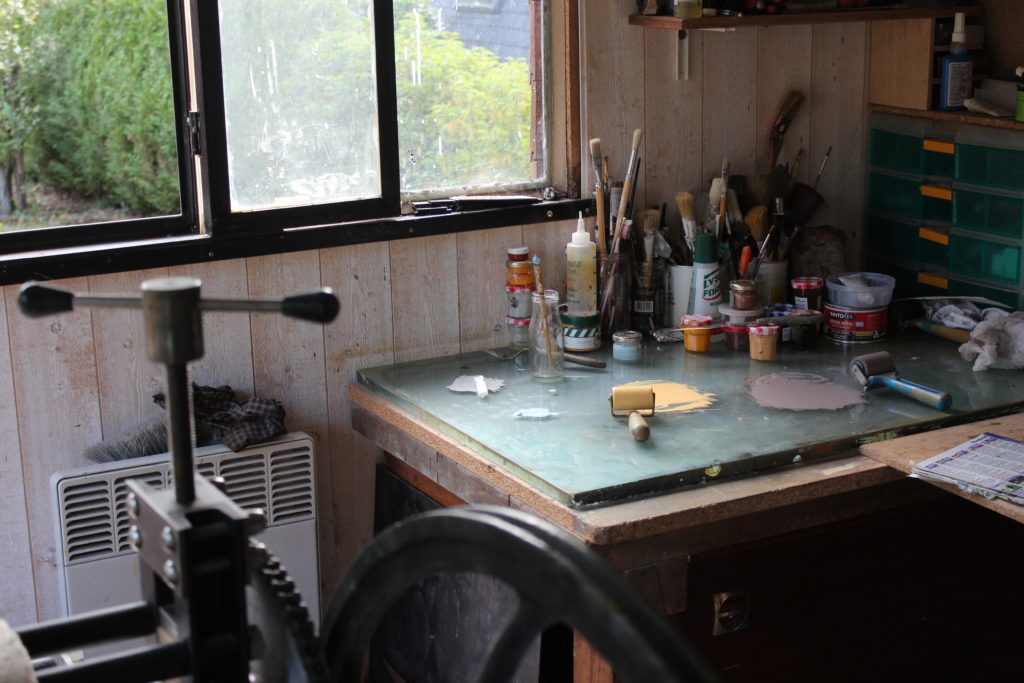
Born in a small village in Tuscany, the artist Giovanni Gorini lives and works between Paris and the Yonne region. A painter and printmaker trained at the Fine Arts Academy of Florence, he has spent several decades exploring a poetic form of abstraction, nourished by history, nature, and decisive encounters. Here, Giovanni shares the story of his journey, his influences, and the sensibility that guides his artistic gesture.
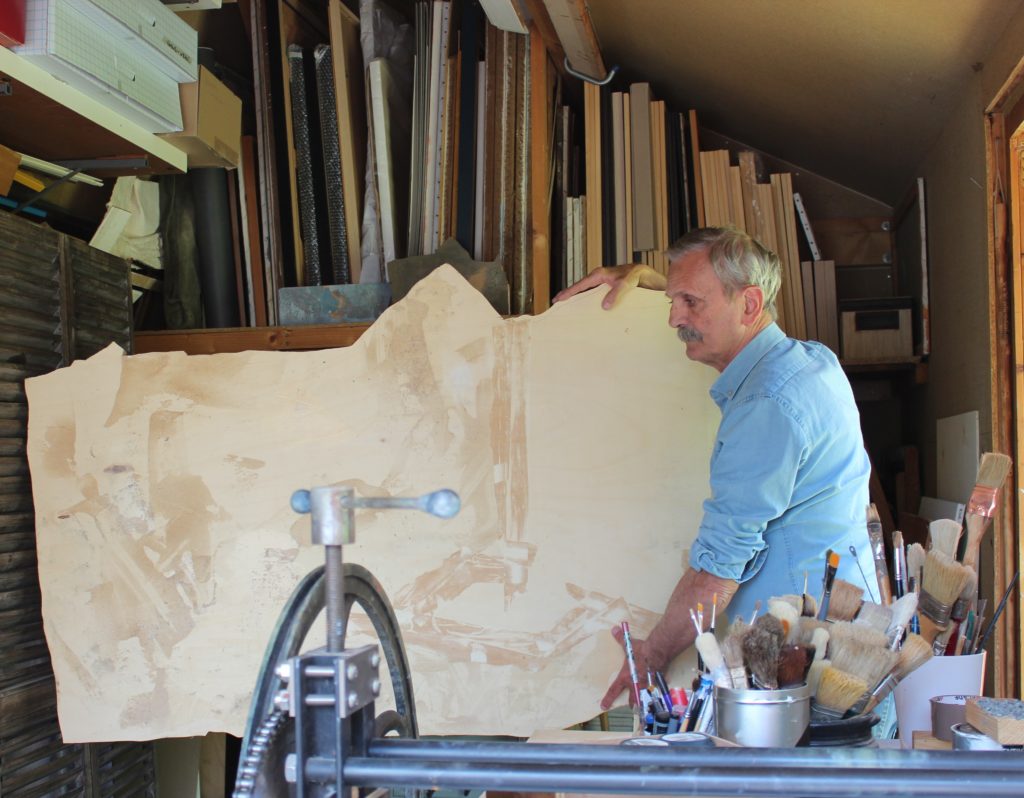
• Giovanni, could you introduce yourself in a few words?
I was born in a small village in Tuscany. After graduating from an art school and from the Fine Arts Academy of Florence, I left Tuscany in 1979 for Paris, which I now share with the Yonne region.
• How did art enter your life?
My brother, twelve years older than me, practiced drawing and painting, and at the age of seven I began to follow him when he went to paint the hills of the Tuscan countryside. These landscapes later became a field of exploration: impressionistic at first, then gradually moving toward more defined formal solutions with contrasts of shadow and light.
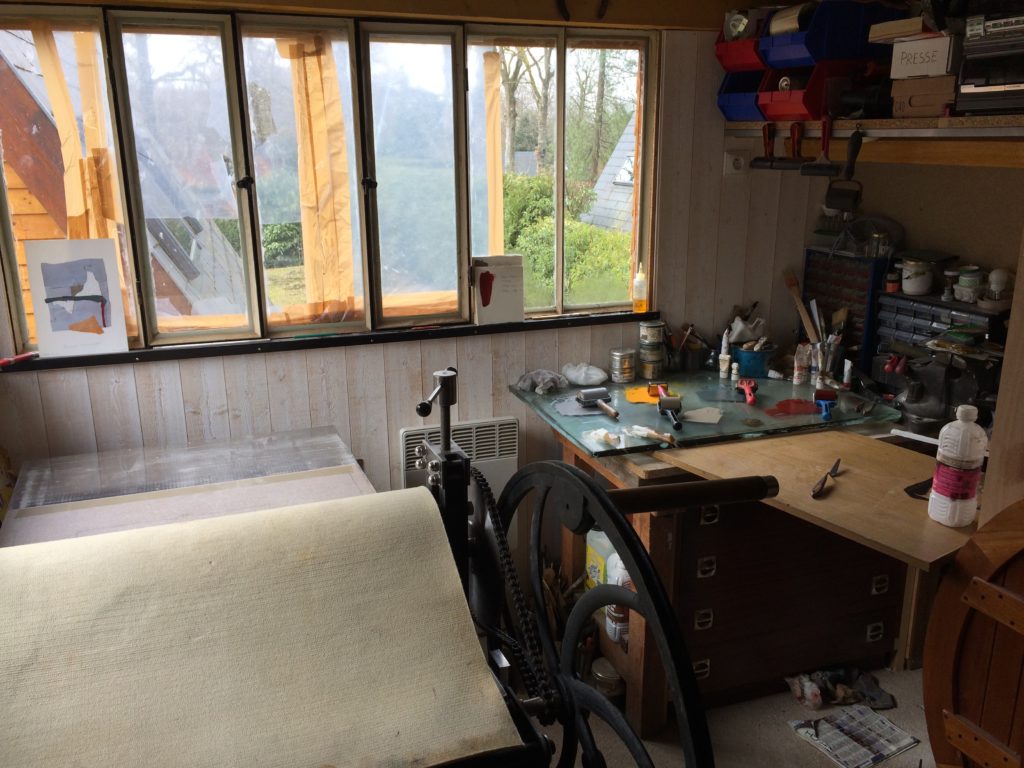
• What kind of artist are you, and what relationship do you have with creativity?
Je suis un artiste optimiste et dans mes créations, j’élimine avant tout le tragique.
• What are your inspirations?
I always start from something real, which I modify according to what I think.
• Have there been artists who particularly influenced you during your journey? If so, which ones and how?
At first, around 1968, my painting was close to that of the “Macchiaioli” (the Impressionists of Tuscany), then to the Impressionists and especially Cézanne. In 1974, I discovered American Abstract Expressionism and, drawn to the gestural style of Pollock, I created my first abstract painting (Astratto No. 1) in order to break away from figurative painting.
But the real change came in 1976 when I discovered the work of Giuseppe Santomaso (founder of the “Gruppo degli Otto” in 1952, a precursor of postwar Italian abstraction), whom I met for the first time that same year in Venice.
• Could you describe your creative process, from the conception to the completion of a work?
At the beginning of the path that leads to the creation of a work lies vision. The eye, as Merleau-Ponty defines it in The Eye and the Mind, is “an instrument that moves itself, a means that invents its own ends; the eye is what has been stirred by a certain impact of the world and restores it to the visible through the traces of the hand.” For me, nature and the real are sources of emotion and formal cues. Forms serve as constructions of space, and space is the primary plastic manifestation of the conception of reality.
To recreate reality through form and material, through color which are the feelings of space and time. This recreated reality also arises through a process of sensitivity, reflection, imagination, and meditation, which finds its spark in the emotions evoked by the visual perception of something seen and experienced.
All these emotions are conveyed to the mind, and the mind transmits them to the hand, which traces them onto the canvas or paper, transforming them into autonomous forms through the artist’s tools: line, space, material, and color.
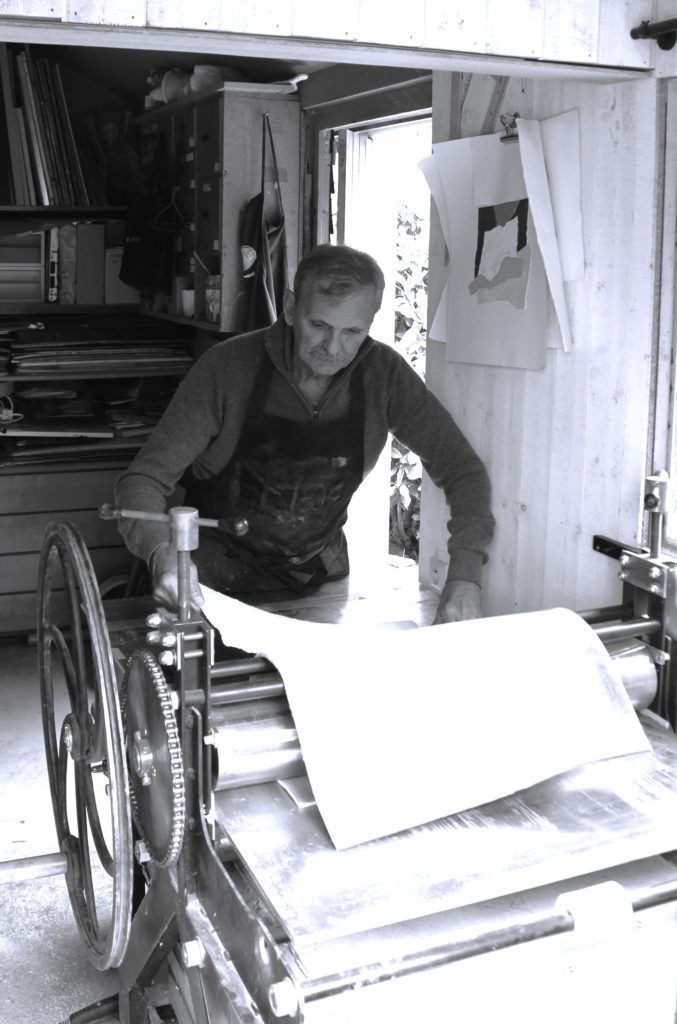
• What role does color play in your artistic work?
It is through color that I express my emotions. Color is emotion, it is memory, and the proportion of forms is determined by the amount of color.
• How would you define your style, your artistic universe?
Poetic. Poetry plays an important role and often inspires my paintings.
• What is your latest artistic work?
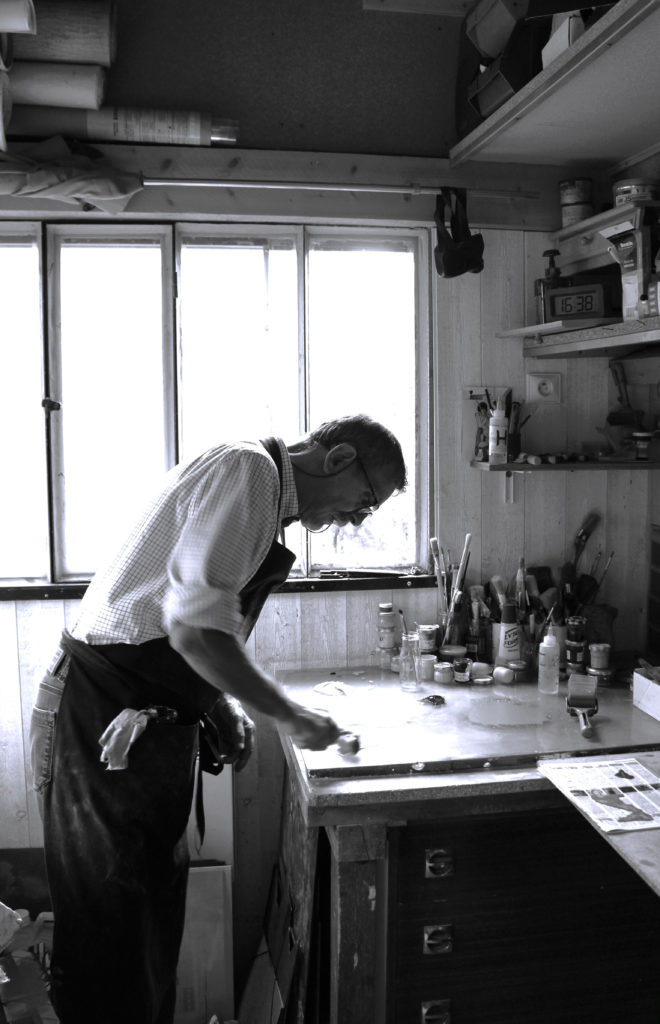
I have just finished printing five 32 × 24 cm prints for the 12th World Print Triennale in Chamalières, which will feature a major retrospective of Pierre Soulages’ printed works, as well as two 52 × 52 cm prints for the upcoming Salon d’Automne in Paris.
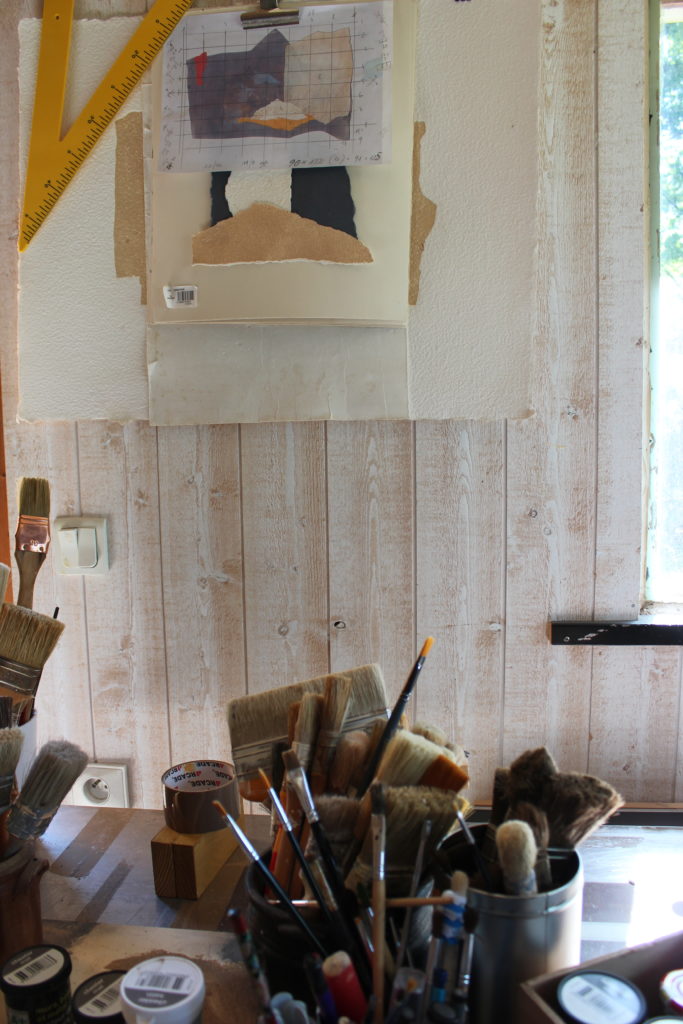
I am also working on a series of relief paintings on wood.
• Since joining the Durst Gallery at the end of 2023, has your style evolved? If so, in which direction has it moved, or where would you like it to go?
At the Durst Gallery, I discovered artists interesting for their diverse themes and techniques. I noticed some very beautiful lithographs, a technique I haven’t tried yet but that greatly attracts me.
• Is there a message or an emotion that you hope to convey through your works?
Conveying a message, conveying emotions, is the essential role of art in communicating with viewers.
What the artist suggests, the painting expresses; the viewer completes it.
• What would you say to someone discovering your work?
Don’t try to understand everything all at once; instead, let imagination and emotion have the chance to grasp it.
• Could you share with us one or two significant moments in your artistic journey so far?
The meetings and exchanges with two poets, Francesco Paciscopi and Dino Carlesi. The conversations and guidance of Giuseppe Santomaso, whether in his studio in Venice or Paris, had a decisive impact on my thinking and style.
The encounter with intaglio printer Mario Boni in his studio on Rue Bénard in Paris, where he introduced me to color printmaking, shared invaluable advice, and offered his friendship.
• Do you have any future artistic projects? In which direction would you like to evolve?
In my future projects, I would like to organize an exhibition of the paintings I am currently working on.
• What would you say to an artist just starting out today? What advice would you give to a young artist?
To have a knowledge of art history, especially that of the 20th century… and to keep a free mind.