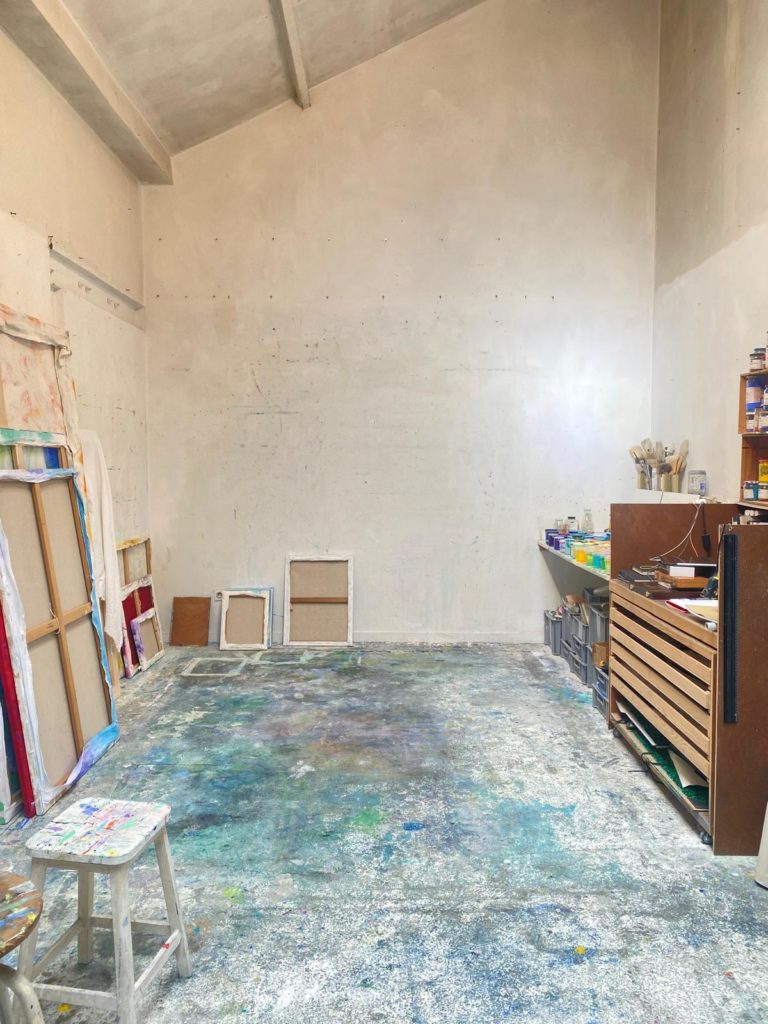
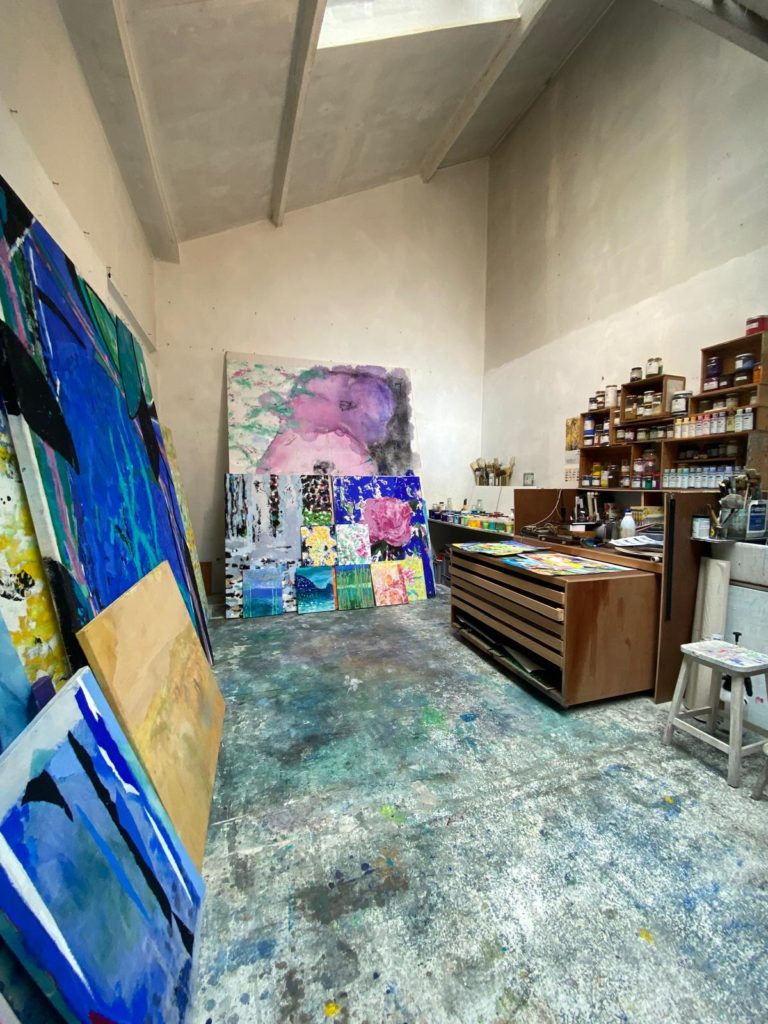
A painter based in Paris, Marc Tanguy opens the doors to his sensitive and colorful universe. Throughout this conversation, he reflects on his beginnings, his influences, and the intuitive way in which he lets painting trace its own path.
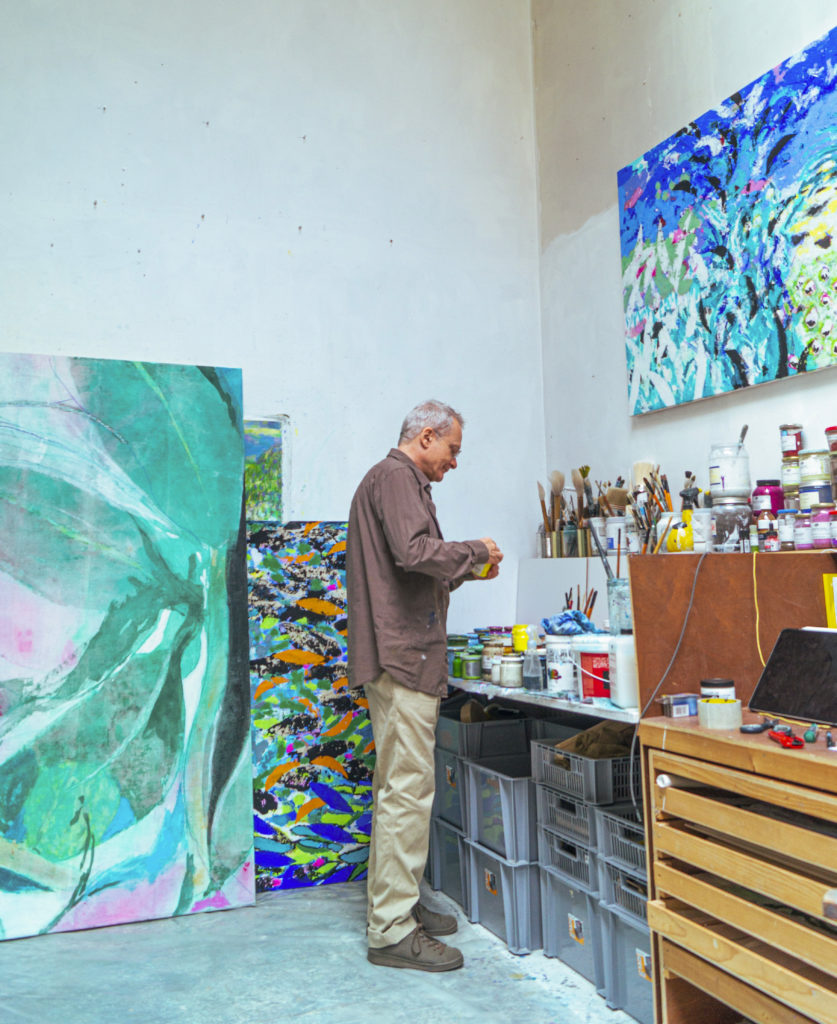
Marc Tanguy workinng in his workshop in Paris. Photo : ©Félix Arramy
• Marc, could you introduce yourself in a few words?
I am a painter, I live and work in Paris.
• How did art enter your life?
If we’re talking about the visual arts, it was through what’s often called ‘popular’ art, comic books, record sleeves, and book covers. I was later shaped by an art teacher in high school who opened my eyes to the history of art and to contemporary art, and who, without me really realizing it, prepared me for the entrance exam to an art school.
• What kind of artist are you, and what relationship do you have with creativity?
I am a painter, and I am interested in how the visible is connected to the rest of our lives. I don’t like elitist art, overly bound by social codes. The creative process is fundamentally an act of freedom, constantly renewed and universal. There are no formulas or repetitions.
• What are your inspirations?
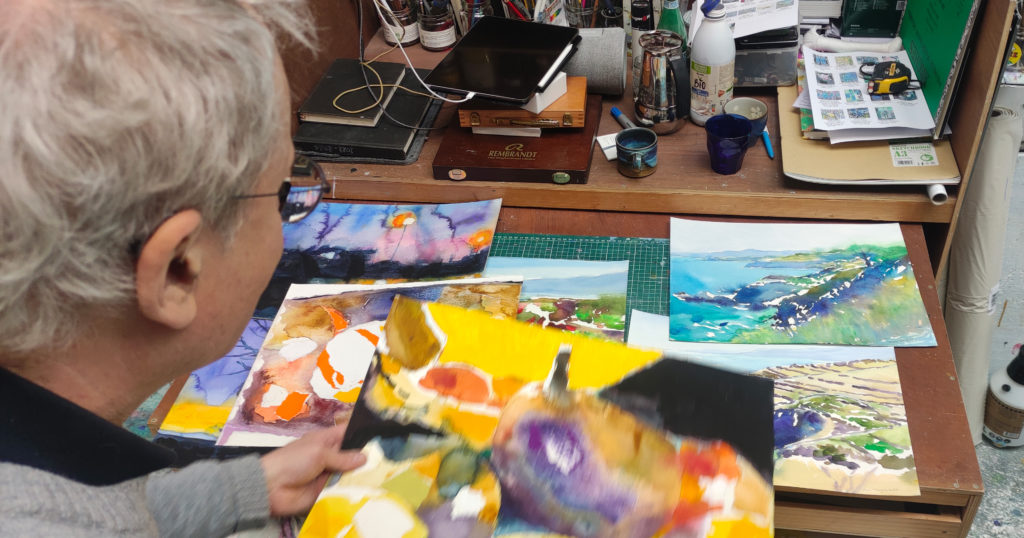
Nature, travels, landscapes, gardens, other artists…
• Have there been any artists who particularly influenced you during your journey? If so, which ones and in what way?
Among historical painters, there are many: Corot, Titian, Joan Mitchell, the Nabis, Tom Thomson, Van Gogh—the list goes on. Among living artists, I think of David Hockney or Peter Doig… I am drawn to that pivotal period at the beginning of the 20th century, around 1906, when painting gradually broke free from social codes and embraced its freedom. It’s a fascinating intermediate period of experimentation, where we see the beginnings of Mondrian, Kandinsky, and the birth of Fauvism.
• Could you describe your creative process, from the conception to the completion of a work?
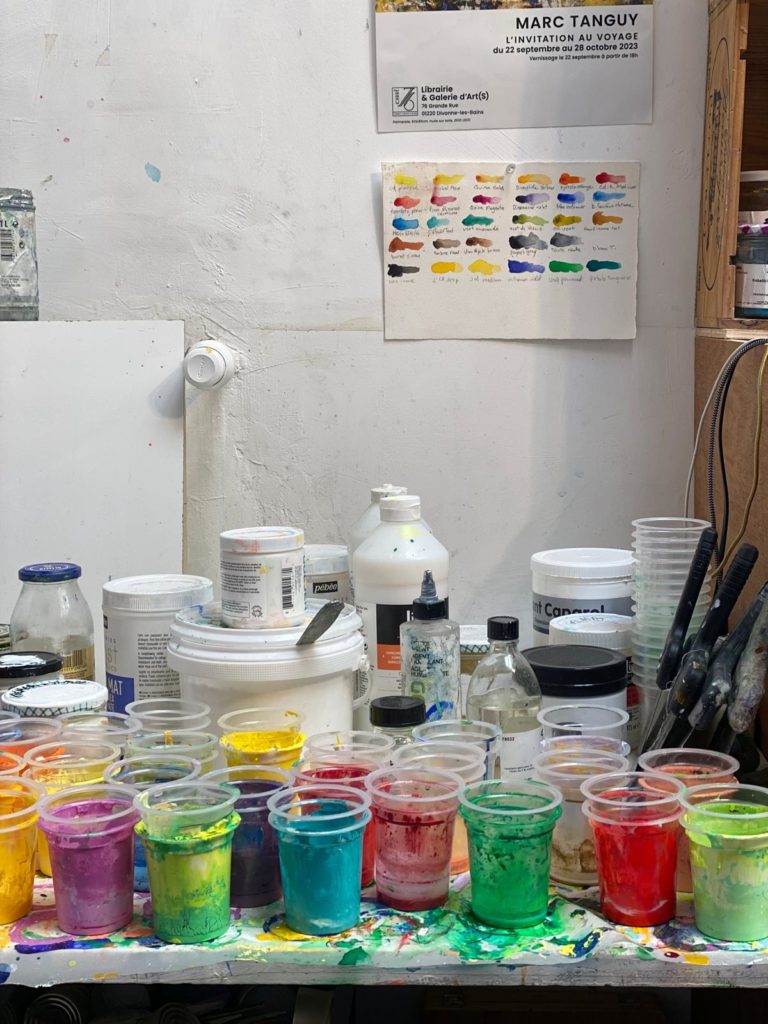
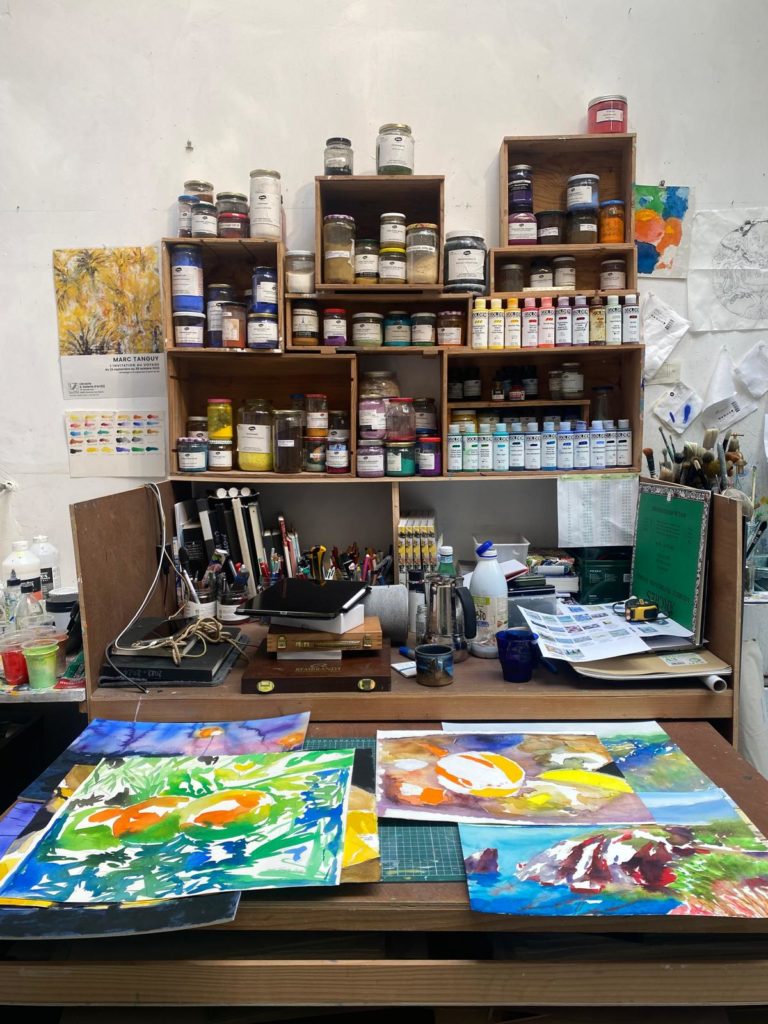
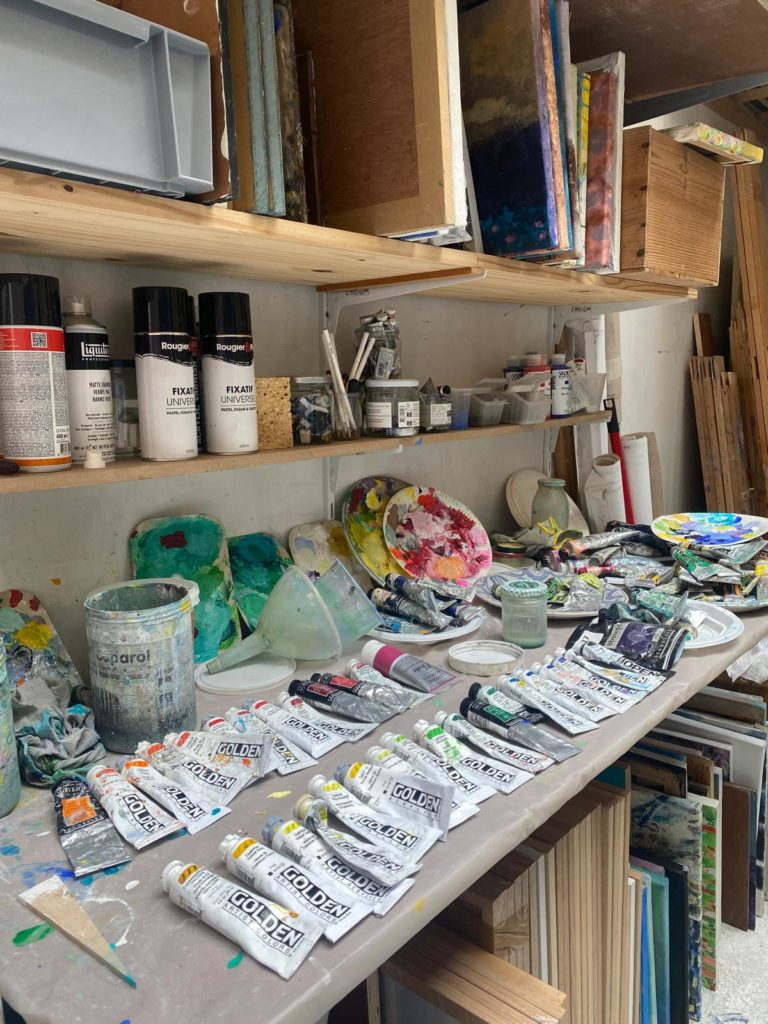
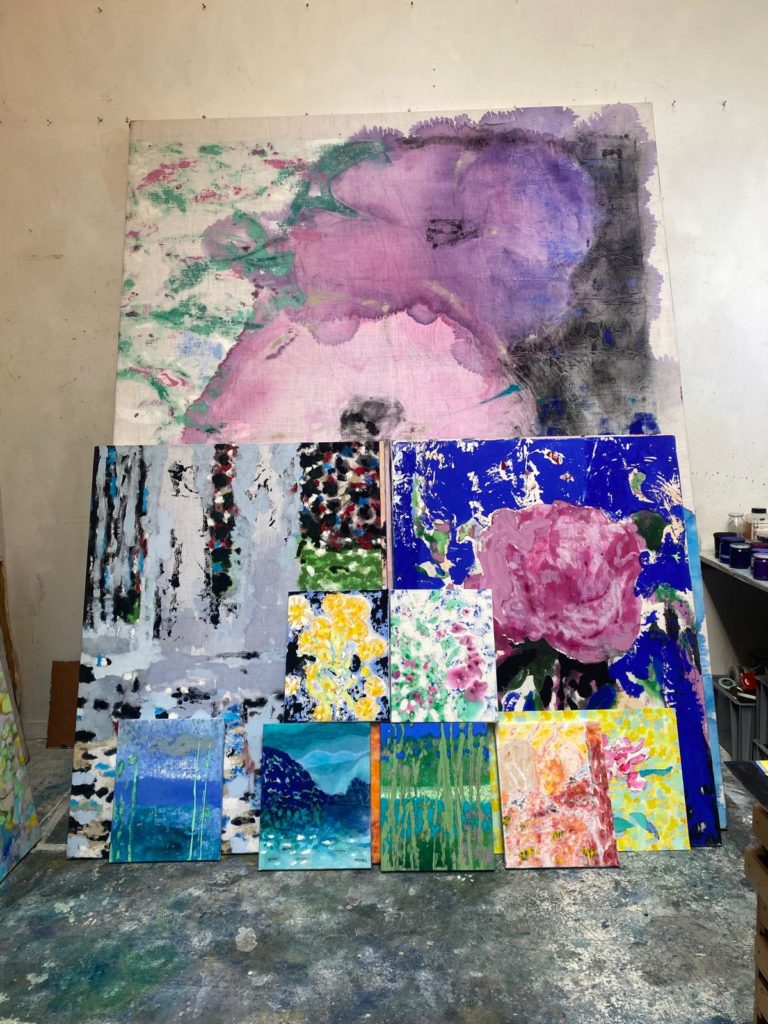
It’s difficult to summarize, especially since it’s a process of constant metamorphosis. At the moment, I work with pure colors, pigments, and a raw white canvas that absorbs paint on both sides, with layers and transparencies. I’m seeking a space that is not perspectival but perceptive, a space of interactions, not social or narrative; historical painting bores me.
The process is generally quite improvised, sometimes starting from a drawing done from life or a photograph. It’s a bit like a journey, I don’t really know where I’m going. It unfolds gradually; I give a certain freedom to the material, to accidents. The painting takes form little by little, it’s a conversation between it and me. All painters know this. Certain elements eventually assert themselves.
• How would you define your style, your artistic universe?
I think style is a bit like a signature or a way of walking. You recognize it, it’s something physical, a way of moving, it’s not intentional and largely unconscious. It’s also a reflection of an era, through the collective unconscious. I can’t describe my style, I don’t have the necessary distance.
My artistic universe is probably connected to nature and to a colorist tradition, from Impressionism through the Fauves, the Nabis, and 20th-century abstract painting.
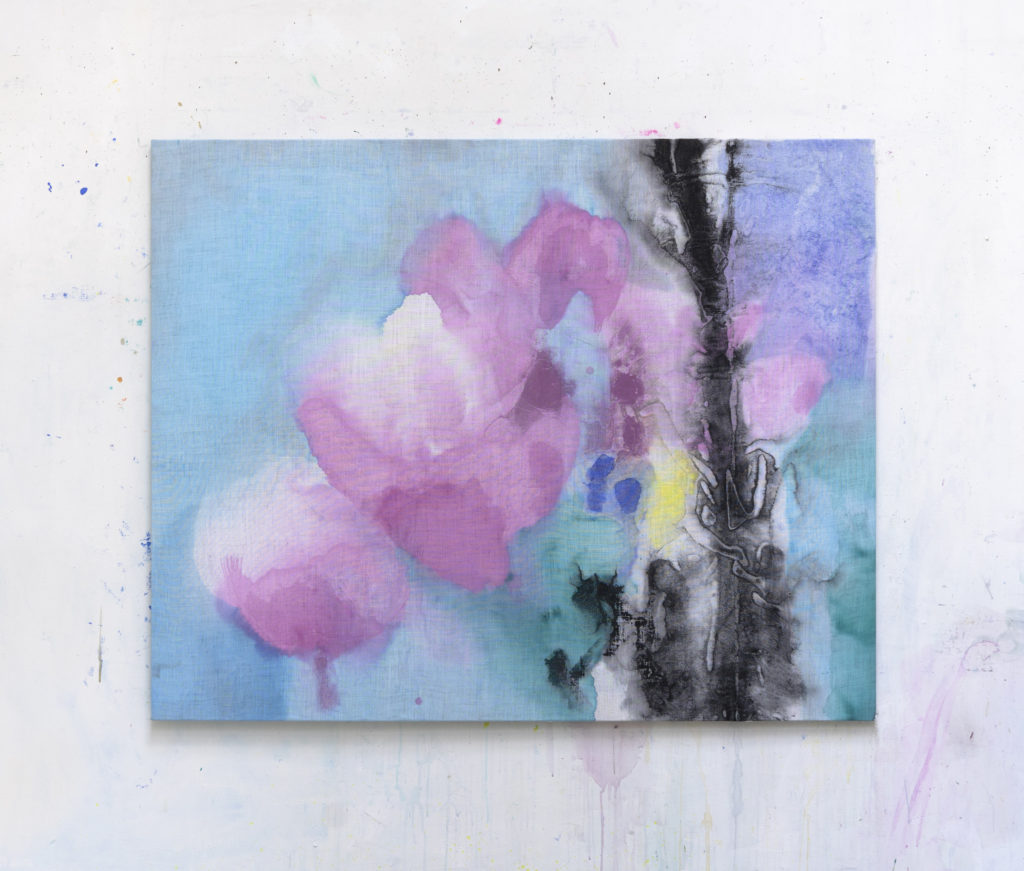
One of Marc Tanguy’s new large-scale works (130 × 162 cm), Magnolia, pigments and binder on canvas, 2022.
• What role does color play in your artistic work?
Color is poetic, direct, it speaks immediately to perception and emotion. For the painter, color is a material, a substance, matte or glossy, thick or transparent, and so on. It is not just a number, as it is in digital images.
You place three spots of color on a white sheet of paper, and you already have a poem. Color allows for harmonies, just like in music.
The use of color by the Fauves, at the beginning of the 20th century, was a pivotal moment in the history of Western art. Painting freed itself from a constrained order.
• Is there a message or an emotion that you hope to convey through your works?
It’s like music, you don’t need a message. I hope the painting is alive, open, accessible, that it has a certain depth, that it’s a space of freedom. Everyone is free to interpret it. I hope it offers multiple entry points, multiple levels of reading.
Furthermore, each painting has its own poetry, it’s not necessarily useful to comment on it. I often paint the sea, but there are a thousand ways to paint it. And it is in the extremely singular that poetry takes shape. Each painting is unique.
• What would you say to someone discovering your work?
It’s up to you 😉
• What is your most recent artistic work?
Apart from studio work, which is ongoing throughout the year, I created a mural for a private client in Hong Kong last year.
• Since joining Galerie Durst in 2020, has your style evolved? If so, in which direction are you moving or would like to move?
I feel that I explore my subjects more deeply, with greater lightness and confidence, working on harmonies I wouldn’t have dared five years ago. I have more freedom. I would like to work exclusively on large formats, to immerse myself in places other than my Paris studio, closer to nature, and to experiment with other atmospheres that will inevitably have an influence.
• You are also represented by Art Of Nature Contemporary Gallery in Hong Kong and by Bernard Chauchet Contemporary Art in London. How did these collaborations come about, and how do they influence your artistic journey?
I don’t think that working with galleries fundamentally changes the nature of my work. It’s more of an adaptation, sometimes involving commissions that remain closely aligned with my own explorations.
The Chauchet gallery presents French artists in London; it’s a bit more complicated at the moment because of Brexit.
My connection with China came a bit despite myself, initially through my mother, who, for some inexplicable reason, was fascinated from afar by an idealized China. She imagined having Chinese ancestors, but it was purely romantic.
Then, especially, through Zao Wou Ki, who was one of my painting teachers at the École des Arts Décoratifs in Paris in the early 1980s. All of this caught up with me when I was invited by a Chinese artist from Paris to participate in an exhibition in China in 2019. I returned there afterward, alone or with groups, and exhibited in several museums as well as at the Hong Kong gallery.
I must admit that I have always been interested in the East-West relationship. As a teenager, I read the Tao Te Ching, Zhuangzi, Herrigel’s book on archery, and so on, the Taoist side. I am interested in Chinese painting, even though I know too little of it; it is rarely seen here, whereas China may be the country in the world where painters are most respected. Writing and painting there are intimately connected.
• Could you share with us one or two significant moments in your artistic journey so far?
In no particular order: the arrival of the internet, giving a global view of pictorial creation, the 1983 Bonnard exhibition at the Centre Pompidou, the Peter Doig exhibition at the Musée d’Art Moderne in Paris in 2008, the moment I began to dare working on large formats, the Covid period, when there was nothing to do but paint, and my travels in Italy, in Rome and Venice.
• You recently collaborated with the brand Atelier Cologne Paris, part of L’Oréal, on a project around a new fragrance called ‘Mandarine Fauve.’ Could you tell us a bit more about this new experience?
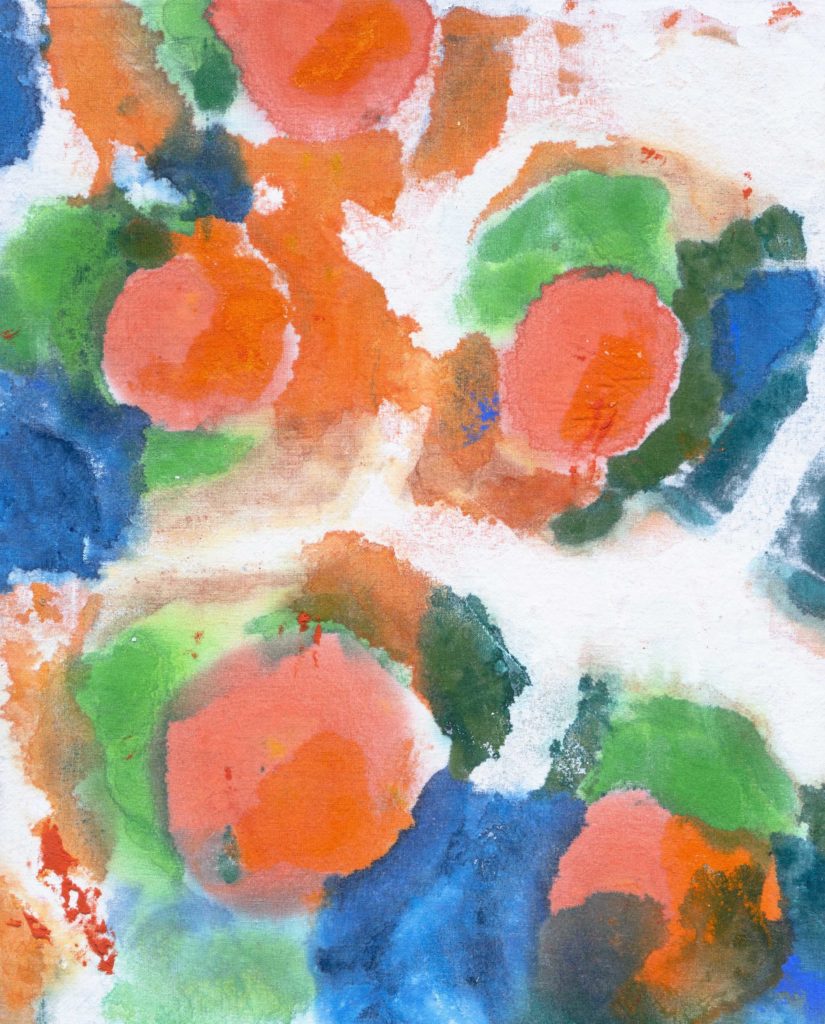
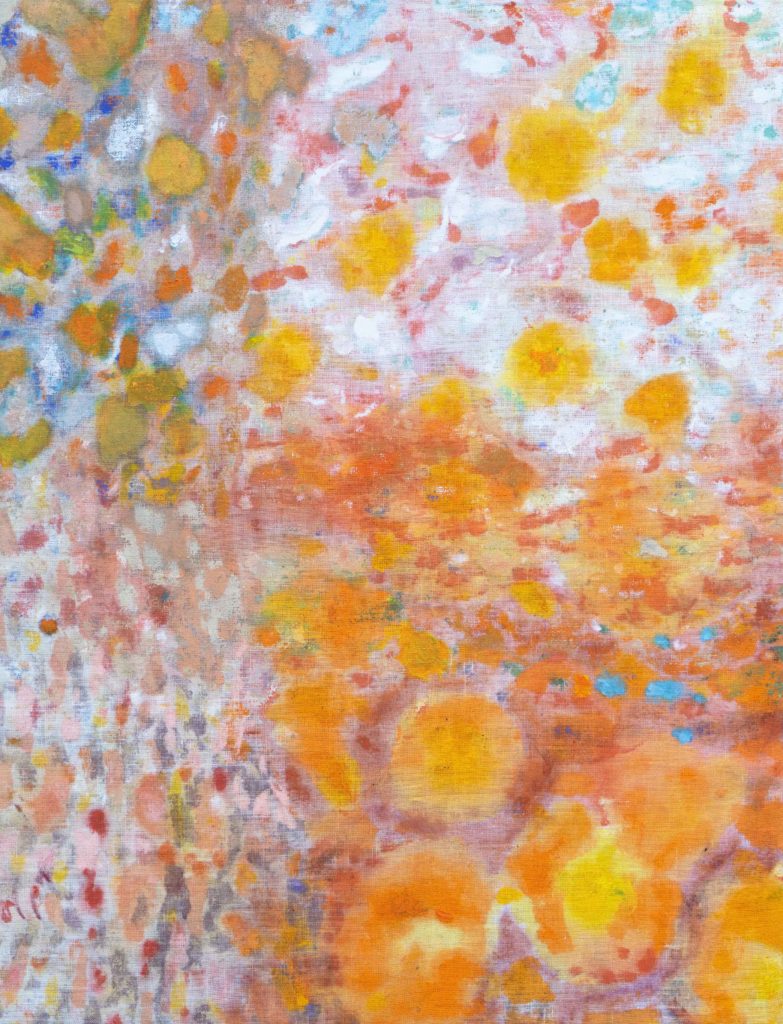
I sometimes work on commission, but for this project, there were constraints related to the product, in terms of colors and the overall spirit. I got to explore the color orange, which I rarely used. I worked with this color to find harmonies and researched pigments and shades. Representing a fragrance was a new experience. It was about establishing visual correspondences with olfactory sensations. Two canvases were created, which were then used for communication, packaging, and so on. It seems that the fragrance launch was a success.
• Do you have any future artistic projects? In which direction would you like to evolve?
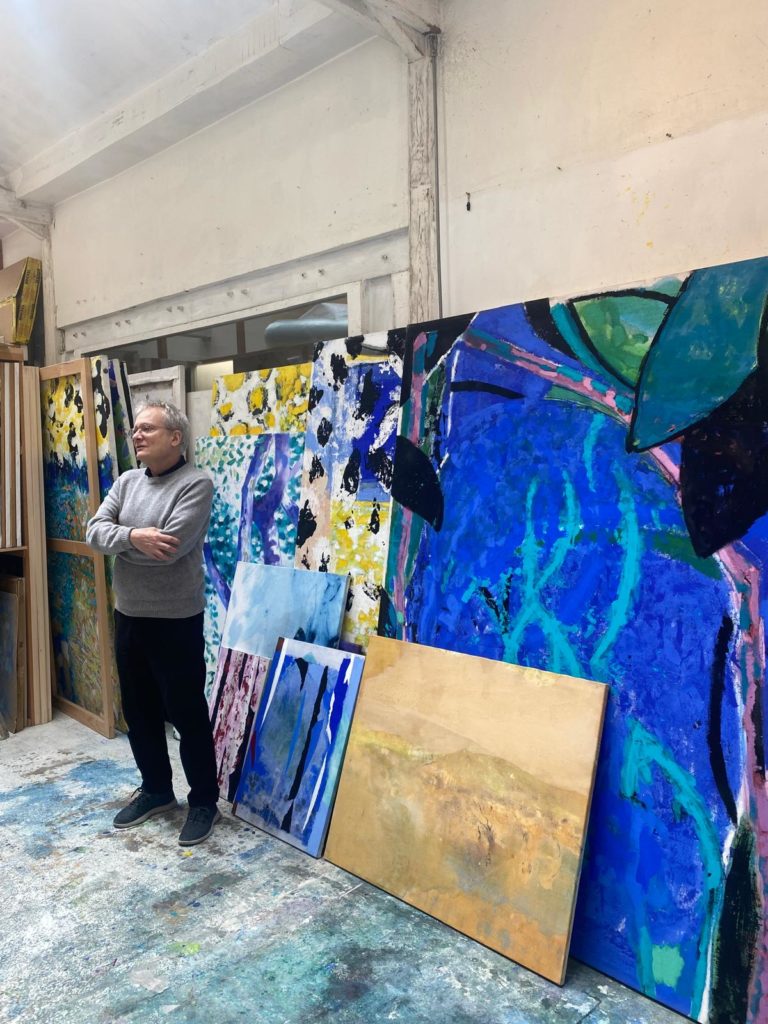
The projects: the Moderne Art Fair with the gallery A Tempera and a residency project with an artist in 2026. I am also beginning research on ceramics, and perhaps returning to printmaking and monotype.
More generally, I would like my painting to be more expansive, working on larger formats—a painting that breathes, simpler, more direct.
• What would you say to an artist who is just starting out today? What advice would you give to a young artist?
I would tell them not to rush, to think of their work in the long term, and to draw inspiration from art history and from nature. But also to reflect on the difference between images and painting. The younger generation is often mesmerized by images and tends to reproduce them on canvas, more or less indirectly. Painting is something else entirely.