- Elisabeth, can you introduce yourself in a few words ?
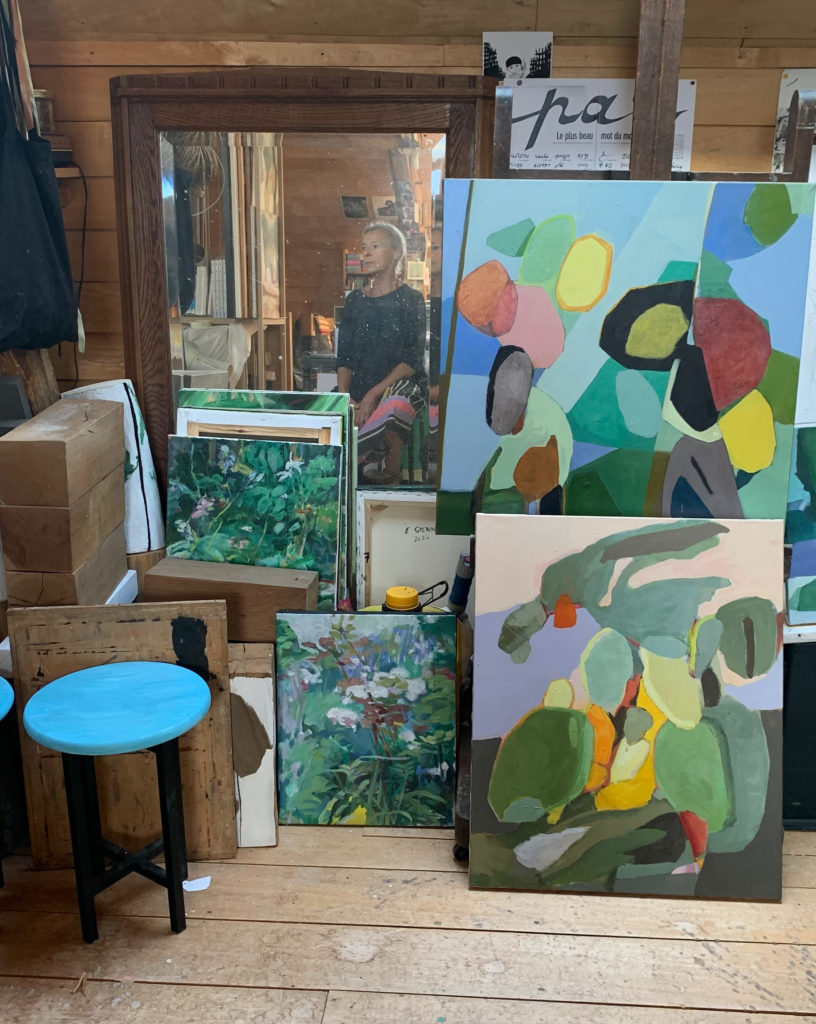
I am Elisabeth Stenne, a painter. For me, the pleasure I experience in painting lies above all in the gesture of the brush and in finding the colors that make me vibrate.
I like to paint in an environment that feels reassuring to me, namely, the open countryside and silence. For me, painting is a form of meditative contemplation.
- Could you briefly tell us about your artistic journey and your training?
After a traditional schooling, I studied at the Beaux-Arts in Reims for three years, then pursued a specialization at the Beaux-Arts in Caen. The two schools had radically different approaches to art, and I felt much more at home in Reims than in Caen. In fact, that year of specialization was very difficult for me, as it called into question everything I had learned in Reims.
- Did you attend the Beaux-Arts with the intention of becoming an artist?
I have always loved drawing and coloring, so it felt natural to pursue artistic studies, without necessarily knowing whether I wanted to become a painter afterward. At that time, I was living in the present, in immediate pleasure. I had no idea whether I wanted to make it my profession or if I would be able to make a living from it.
- And after those 4 years ?
After those four years, I did various things that took me somewhat away from painting. I only returned to it in my thirties. In fact, it was largely thanks to my husband that I came back to it, and because I felt at ease in my life at that time.
- How do you express yourself as an artist ?
Painting is, for me, the form of expression I handle best, and the one that pushes me beyond my own limits. I never know whether viewers will like the paintings I create, and that’s precisely what makes this medium so stimulating for me.
I also really enjoy expressing myself through language, whether in writing or speech. But writing is a form of expression I prefer to keep private.
Writing, for me, is the equivalent of a small painting. What triggers my desire to write is a memory of something that pleased or moved me. I need to express the emotion I felt and the reasons why I felt it.
- Is writing, for you, connected to painting?
Not really, but sometimes my writing is suggested by an image, something I have seen. What is certain is that, for me, everything first passes through the eye. It may be a small emotion that I later develop in my paintings. But it can also stem from a rose, a particular shade of pink I am not accustomed to, which at a given moment evokes an emotion that I then write about. I can then use it as a starting point for a painting.
What is certain is that the creative process is intimately connected to all the emotions we experience, and painting and writing sometimes converge.
- So it is your eye that dictates everything?
Always. My painting does not convey any particular message and is not intended to do so, other than to convey the beauty of the world and the beauty of colors. I translate what I enjoy seeing, whether in a figurative or abstract style.
That is why I define myself above all as a painter of colors.
I like to present a color, a harmony of colors, and the vibration it creates. What is certain is that the creative process is intimately connected to all the emotions we experience, and painting and writing sometimes come together.
- So it is your eye that dictates everything?
Always. My painting does not convey any particular message and is not intended to do so, other than to convey the beauty of the world and the beauty of colors. I translate what I enjoy seeing, whether in a figurative or abstract style.
That is why I define myself above all as a painter of colors.
I like to present a color, a harmony of colors, and the vibration they create.
- Are you inspired by nature ?
Yes and no. I am inspired by the colors found in nature. I have painted many flowers throughout my career. In fact, as a child (around 12 or 13), I copied a lot of Paul Gauguin, with his sumptuous landscapes and colors.
When I returned to painting after my studies, I began with pastels, more specifically floral pastels or rural landscapes. In fact, I drew everything around me, landscapes, gardens…
It was later, when I was discovered by a gallery in Azay, that I moved away from my preferred subjects and began to explore abstraction more.
Each new encounter with gallery owners has allowed me to evolve toward something different. For example, until I met Françoise Durst, I worked exclusively in pastels. Afterwards, I began to paint.
- Is there a particular color that makes you happy?
I like all colors, but green is the foundation of my work. Green is what makes all the other colors resonate. In nature as well, green is the base, and flowers bloom within it.
- How would you describe your creative process ?
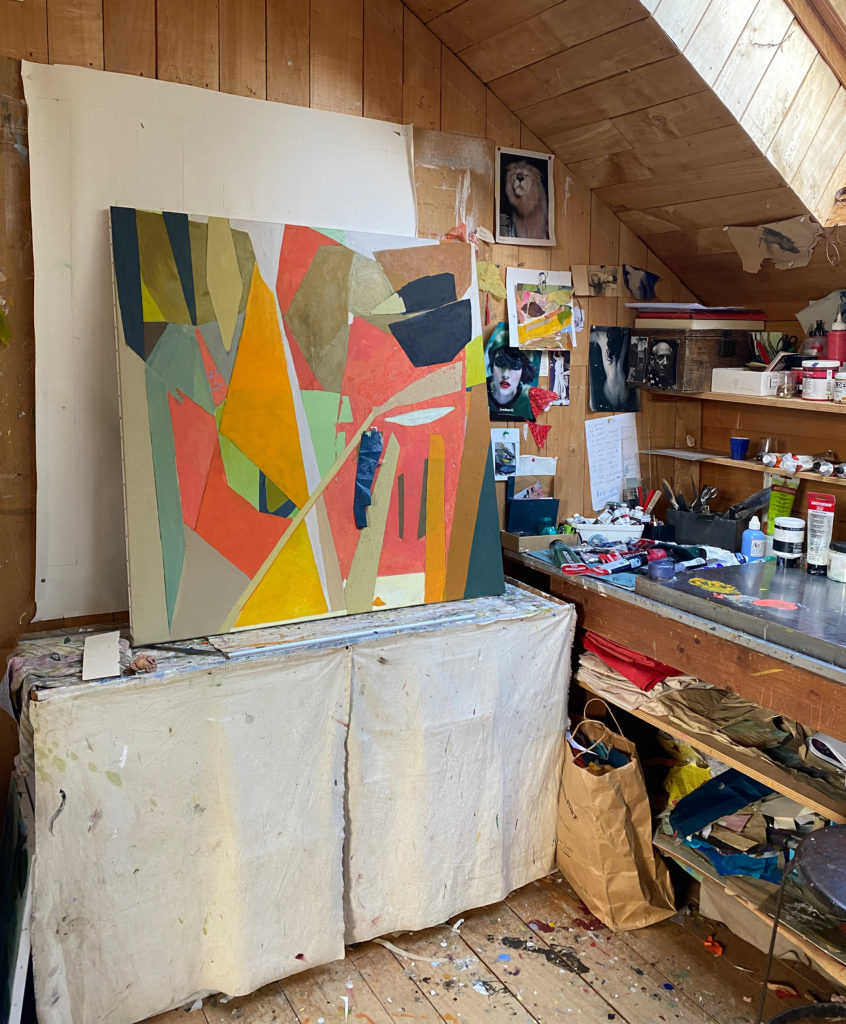
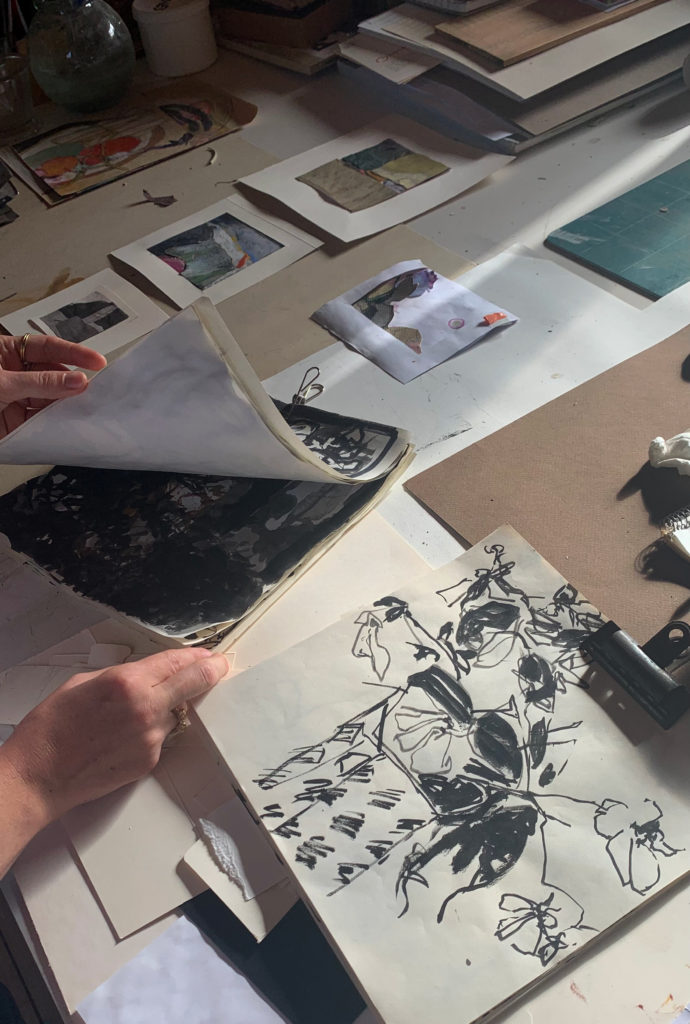
In winter, I do a lot of collages, using earlier works that already have a certain material quality, which I then transform. For me, the color of pastel is something very beautiful and provides a highly inspiring and interesting foundation. On this base, I create compositions.
When summer arrives, I return to the collages I created during the winter, using them as inspiration for my paintings.
I also incorporate the principle of collage into my paintings, as I glue paper onto the canvas to develop my compositions. I gradually remove the papers as I find the color combinations and forms that satisfy me.
Once the composition is created, I photograph it and convert it to black and white, or even invert it and view it in different orientations, to confirm that the composition holds together. I use this to assess whether the painting has strength in its tonal contrasts. For me, color is very intuitive, so what I focus on most is composition.
Exhibition “Vibrations” by Elisabeth Stenne from October 7 to November 5, 2022, at the Durst Gallery.
Opening reception with the artist present on October 6, 2022, starting at 6:00 PM.
Discover the first works of the exhibition by clicking here