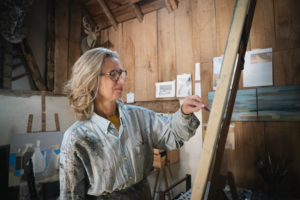
Durst Gallery is delighted to present Marie-Astrid Grivet’s new solo exhibition. Staying true to the themes that have long informed her practice, still lifes, rocks, bodies, and staircases, the artist continues her pictorial exploration, in which forms, surfaces, and color engage in a subtle balance between abstraction and figuration.
This new exhibition also marks the emergence of a more recent theme in her work: the human figure. Inspired by movement and, at times, by the world of dance, these figures encounter one another, respond to each other, and occupy the space in compositions where bodies become surfaces of expression. We sat down with the artist, who shares with us the inspirations and behind-the-scenes insights behind this new exhibition.
How did you approach this exhibition?
I really wanted this exhibition to be different from the one I did four years ago, both in terms of technique and development. We always want to evolve, and I wanted the public to discover something new in my work.
Maybe it wouldn’t have been so difficult to simply do what I already knew how to do, to stick to my usual colors and subjects, but I wanted to shift things a little. I don’t think I managed to do that with every painting, but there are some that I’m really happy with, where I feel that I’ve made progress.
How did you approach creating the works for this exhibition?
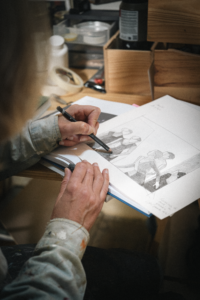
I leave room for intuition, but I’m also very organized. I make sketches and think a lot about my next two or three paintings, because I don’t like being caught off guard and having to wonder each day what I’m going to work on.
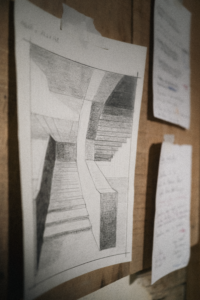
So I don’t improvise completely: I think beforehand about the subjects I’m going to work on. Then, the sketch also leaves room for intuition, because that’s where the creative process begins.
My black-and-white sketches help me think about the tonal values of the colors. Value is very important: for example, red and black have the same value, so if you photocopy them in black and white, they will both appear black, whereas yellow will come out more like a light gray.
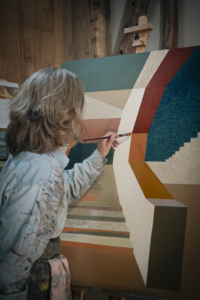
Once the sketch has been transferred onto the canvas, I make a fairly quick first pass to establish the colors and the overall harmony I’m looking for. Then I leave more room for intuition: I work on the colors, materials, and textures. I ask myself whether I’m going to use a denser layer of paint, a glaze, impasto, a line… At that point, I let myself be guided by what is happening on the canvas.
The initial composition gives me confidence. If it’s right, I know I’ll be able to move forward with the colors. But if it doesn’t work, and that has happened to me before, no matter how many times I change the colors, I just can’t make it work.
Is there a common thread running through the works?
Not really, other than this desire to go further than what I was doing before. Maybe that’s the common thread: taking one step further.
I’m happy because these are all things I genuinely wanted to make, without forcing myself or feeling the need to add a work just to complete the exhibition. It was very important to me to paint, rather than simply produce.
What influences have informed the creation of this exhibition?
In this exhibition, you’ll find my usual themes: still lifes, rocks, bodies, and staircases.
I really love rocks, their raw texture and their highly graphic forms: edges, lines, curves. The rocks I paint are generally ones I’ve photographed, particularly in the Limousin region. They allow me to move towards something more abstract, less representational. It’s a form of escape, but also a nod to the Limousin, which is a part of who I am.
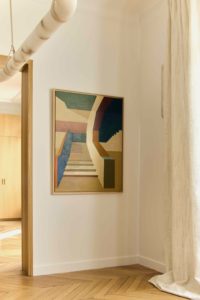
All my works are inspired by the photographs I take. I could paint staircases all the time. I love the interplay of lines and curves, but also the sense of openness and movement they create. They come from staircases I encounter, and now, amusingly, people send me photos of staircases, and some of them are fantastic.
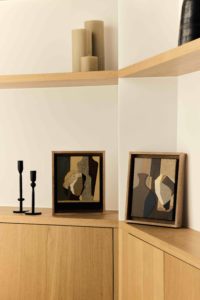
Still lifes are also present because they are restful for me, not only in the sense that they help me relax, but because they allow me to construct something. For me, a still life is above all an exercise in composition. I have a large collection of images of bottles and home décor magazines that I use as inspiration to recompose my scenes.
I draw a lot of inspiration from nature. I planted cypress trees because I love vertical lines, shapes that rise upward. I planted three because they are a symbol of welcome. I also planted a quince tree so I would have quinces to paint. I find it a beautiful fruit, with an irregular, knobbly shape.
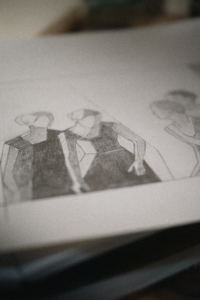
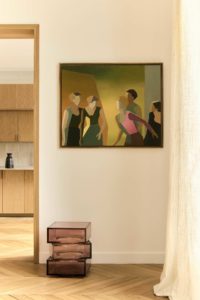
Finally, for some time now, I’ve been exploring a more recent theme: figures, with an inspiration that sometimes draws from dance. These are figures that I want to have interact with one another. I like working with bodies as surfaces and trying, despite my style being close to abstraction, to convey the interactions between the figures. Even though they sometimes have faces that look like masks, I would like the viewer to sense, through the lines and curves, a relationship between them.
Is there a work in the exhibition that is particularly meaningful to you?
There’s one in particular that I’m especially fond of because its inspiration came from a photography exhibition I saw at the Maison de la Photographie in Paris.
At first, I thought I wouldn’t go to see this artist because I didn’t think I would like their work. Then I thought it would be a shame to miss it, and in the end, I discovered two or three photographs that I loved so much.
I created a painting based on this inspiration. I laid it down fairly quickly because I could tell it was working, even though I later had to rework a large part of the composition. In the end, it required a great deal of work.
This painting is particularly meaningful to me because it depicts figures, which is something quite new for me. I love the harmony of the colors and what happens between the figures. I think it may come as a surprise: this departure from my usual work is something I stand by.
What do you hope visitors will take away with them?
I’m not trying to create agitated paintings that unsettle or overwhelm people. I want my paintings to feel calm and composed. That’s something I’m looking for: even in the way I apply the paint, I need it to have a calming effect on me.
I’d like people to feel that my paintings make them think, that they engage them, but also that they make them feel good.
That doesn’t mean I’m looking for paintings that are too restrained or perfectly aesthetic. On the contrary, I like there to always be a little element that feels unsettling, something that “grates,” even if I don’t always manage to achieve it.
I also hope that people will come and discover the work that galleries do, because I think it’s wonderful that they continue to exhibit artists. It’s different from looking at artworks on a computer: there’s a whole process involved in the exhibition design, the way the works are hung, and how they are presented. And for those who already knew my work, I hope they’ll see an evolution,and, above all, that it’s an evolution in the right direction. That it’s not a major downfall!
Exhibition from October 1 to October 29, 2026, at Galerie Durst
Opening reception on Thursday, October 1, from 6:00 to 9:30 p.m.
Discover all the works in the exhibition